
A number of states require E-Verify, but the rules are not the same everywhere. E-Verify stays voluntary at the federal level for most private employers, and federal law only requires it for federal contractors with the FAR E-Verify clause. States fill in the rest of the picture, and each one draws its own lines.
Some require every private employer to run new hires through the system. Others only require it for public agencies or government contractors. Two states limit how employers can use it at all.
This guide breaks down where your firm's clients stand today, what changed in the past year, and what is likely to change next.
Key Takeaways
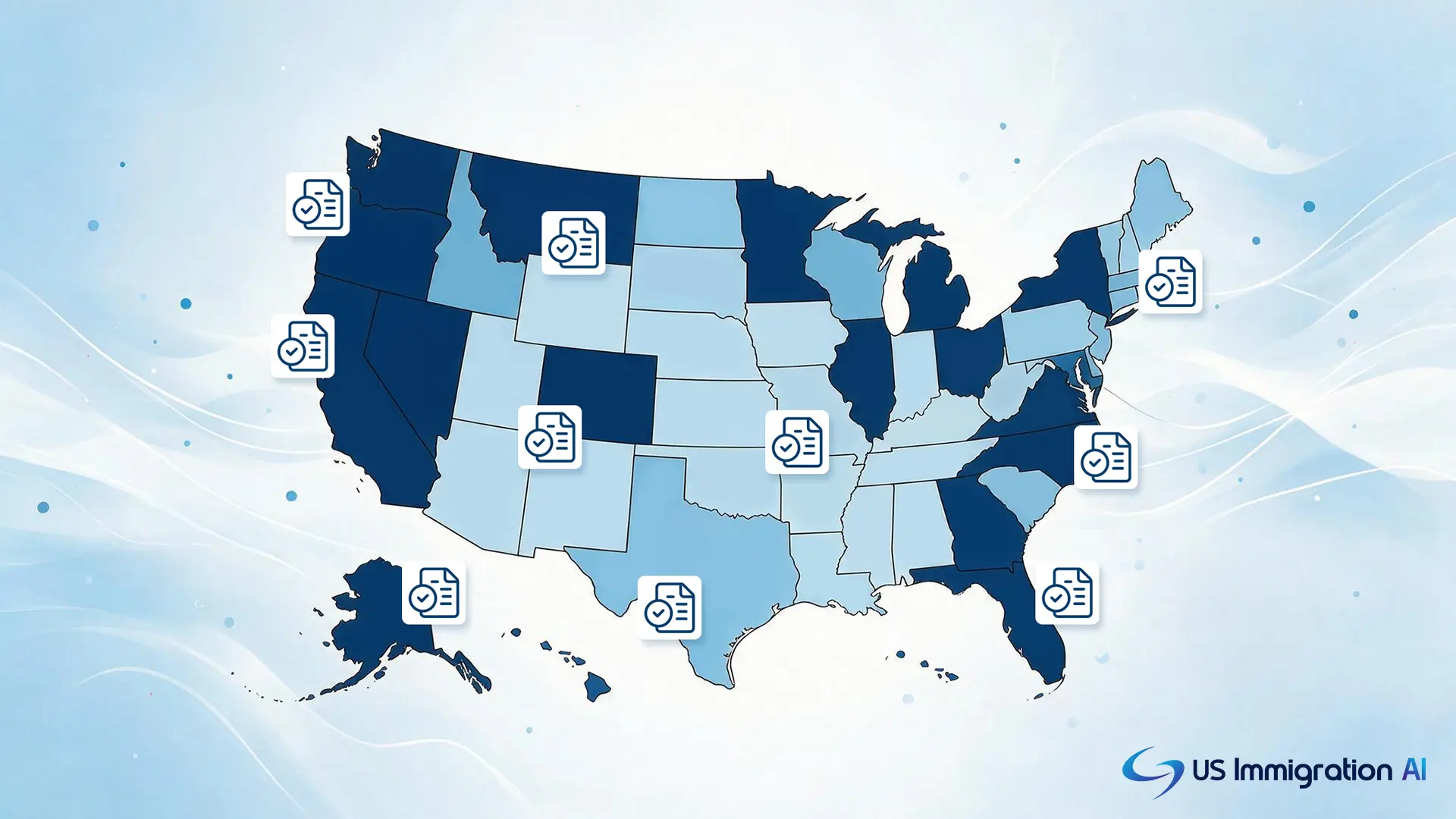
- Nine states require E-Verify for all or nearly all private employers: Alabama, Arizona, Georgia, Louisiana, Mississippi, North Carolina, South Carolina, Tennessee, and Utah. Florida also requires it above a size threshold.
- Montana requires employers to use E-Verify or keep specific work authorization documents on file, a hybrid approach Louisiana also follows.
- Indiana's FAIRNESS Act, effective July 1, 2026, does not mandate E-Verify outright. It bans knowingly hiring unauthorized workers and treats E-Verify use as a legal safe harbor.
- Ohio now requires E-Verify for nonresidential construction contractors, subcontractors, and labor brokers under a law that took effect in March 2026.
- California and Illinois do not mandate E-Verify. Both restrict how employers who choose to use it can apply it.
What "Requires E-Verify" Actually Means
E-Verify is a free system run by U.S. Citizenship and Immigration Services and the Social Security Administration. It checks the information on an employee's Form I-9 against federal records to confirm work authorization. Every employer in the country must complete Form I-9 for new hires. E-Verify is a separate, additional step on top of that.
At the federal level, E-Verify participation is voluntary for most private employers. Federal contractors with the FAR E-Verify clause (52.222-54) are the main exception, and they have been required to use it since 2007. Beyond that, whether a firm's client must use E-Verify comes down entirely to state law, since states are free to set their own mandates on top of the federal baseline.
States That Require E-Verify for Most or All Private Employers
These states require most private employers to run new hires through E-Verify, with a few applying the rule only above a certain headcount.
Several of these mandates go back further than employers expect. Alabama's law, confirmed on the state's own E-Verify enrollment site, has applied to every employer with at least one employee since 2012. Arizona's Legal Arizona Workers Act, described by the Arizona Attorney General's office, has required E-Verify for all new hires since 2008. Georgia phased its mandate in by company size before settling on the current 10-employee threshold, codified at O.C.G.A. § 36-60-6.
Florida's 25-employee threshold is more recent: it took effect July 1, 2023, under Florida Statute 448.095. Mississippi's law, at Miss. Code § 71-11-3, is unusual in explicitly reaching contractors and subcontractors, not just direct employees. North Carolina's 25-employee rule is laid out in the state labor department's own E-Verify FAQ. South Carolina's all-employer mandate runs through S.C. Code § 41-8-20.
A few of these deserve a closer look. Louisiana and Montana do not force every employer onto E-Verify outright. Under Louisiana Revised Statute 23:995, an employer avoids civil penalties by either verifying every employee through E-Verify or keeping a copy of specified identity and citizenship documents on file. Montana's Legal Employment and Government Accountability Law, effective July 1, 2025, works the same way, and the Montana Department of Labor and Industry outlines both compliance paths.
Tennessee's threshold has moved twice. The Tennessee Lawful Employment Act originally applied to employers with 50 or more employees. As of January 1, 2023, that dropped to 35 or more full-time equivalent employees under the same federal employer ID, counting workers both in and out of state. The Tennessee Department of Labor and Workforce Development confirms the current threshold and the alternative document list available to smaller employers.
Utah's 150-employee threshold carries a wrinkle worth flagging to clients. The statute is officially labeled "Contingently Repealed" in the Utah Code: it will sunset once the state's guest worker program receives federal approval or by July 1, 2027, whichever comes first. Neither trigger has happened yet, so the 150-employee mandate remains in force, but risk-averse employers should watch for updates rather than assume the rule is fixed permanently.
States That Require E-Verify Only for Public Employers and Contractors
Most other states with any E-Verify law limit it to government agencies, public contracts, or businesses receiving public money. Private employers in these states are not required to use E-Verify unless they fall into one of those categories.
Ohio belongs in its own category. The Ohio Legislature's text of House Bill 246, the E-Verify Workforce Integrity Act, created a mandate specifically for the construction industry rather than a general public-contractor rule.
Signed in December 2025 and effective in March 2026, it requires nonresidential construction contractors, subcontractors, and labor brokers to run E-Verify on every new hire, with penalties reaching into the tens of thousands of dollars for repeat violations. Residential construction is exempt.
Indiana: A Mandate That Isn't Quite a Mandate
Indiana's FAIRNESS Act (Senate Enrolled Act 76) is worth a section of its own, because it gets mischaracterized often. The law, effective July 1, 2026, does not require Indiana employers to enroll in E-Verify.
Instead, according to the official bill text from the Indiana General Assembly, it makes it unlawful for any employer to knowingly or intentionally recruit, hire, or continue employing a worker who lacks authorization to work in the United States.
E-Verify enters the picture as a defense, not a requirement. An employer that verifies a worker through E-Verify gets a rebuttable presumption that it did not knowingly hire an unauthorized worker, which is the strongest protection the statute offers.
An employer can also rely on other "reasonable diligence," though the law does not spell out exactly what that means. For a firm advising Indiana employer clients, the practical message is the same either way: using E-Verify is the clearest path to that safe harbor, even though the statute stops short of ordering it.
States That Restrict E-Verify Use
Two states go the other direction and limit how employers can use E-Verify, even voluntarily.
California does not require E-Verify and blocks state and local governments from mandating it. Under Assembly Bill 1236, no California city, county, or the state itself can require a private employer to use an electronic verification system as a condition of a business license, a government contract, or a penalty under other licensing laws.
A related law, AB 622, went further in 2015 and made it an unlawful employment practice to use E-Verify on an existing employee or on an applicant before a job offer, with civil penalties up to $10,000 per violation.
Illinois takes a similar approach. Employers who choose to use E-Verify must notify employees, cannot use it to prescreen applicants, and must follow specific posting and attestation requirements under state law.
Neither state prohibits E-Verify outright. Both make clear that voluntary use has to follow the federal rules on timing and consistency, and that misuse carries a real cost.
States Where E-Verify Remains Voluntary
Roughly half the states have no state-level E-Verify law at all. In these states, private employers can enroll in E-Verify if they want the added documentation and legal protection it offers, but nothing in state law requires it.
Federal contractors in these states still have to comply with the FAR clause regardless of what their state does. New York, Washington, Colorado, and Massachusetts fall into this group, along with most of the Northeast and a scattering of states elsewhere.
A handful of cities and counties, particularly in Washington state, layer on their own local E-Verify rules for contractors even where the state itself stays silent, so it is worth checking local ordinances in addition to state law.
2026 Changes Worth Watching
State E-Verify law moves fast, and firms with clients in multiple states need to track it the same way they track visa bulletin movement. A few developments from the past year stand out.
Florida lawmakers introduced a bill in the 2026 session to extend the state's E-Verify mandate to all private employers regardless of size. It passed the House but died in the Senate Rules Committee, so the current 25-employee threshold still stands. Expect a similar bill to return in 2027.
Texas has a bill pending that would extend its current state-agency and contractor mandate to private employers statewide, though it has not passed as of this writing. New York has seen the opposite kind of bill, aimed at restricting municipal E-Verify mandates and adding new protections against misuse of the system on existing employees.
None of this is final, and firms should treat pending legislation as a reason to check back rather than a reason to advise clients as if it has already passed.
Why This Matters Beyond HR Compliance
E-Verify usually lands on an HR team's desk, not an immigration attorney's, but the two responsibilities overlap more than they used to. A firm handling PERM labor certifications, H-1B petitions, or other employment-based immigrant visa cases is often working with the same employer clients who are trying to figure out their state E-Verify obligations.
Getting the state picture right protects the employer from a state-level compliance problem while the firm handles the federal sponsorship case, and it avoids the awkward situation of a client relying on outdated guidance from a payroll vendor's blog post.
As state mandates expand and firms take on more corporate immigration work as a result, it helps to know which state rule applies to a given client before advising on the broader hiring picture. A quick check against the current statute, not last year's summary, is the safest starting point.
Mandatory E-Verify vs. Federal Contractor Requirements
Firms sometimes conflate a state E-Verify mandate with the federal contractor requirement. They are not the same thing, and the difference matters for advising clients correctly.
Where This Leaves Employers and Their Counsel
State E-Verify law is not settling into a stable pattern. More states are adding mandates, a few are narrowing them to specific industries like construction, and a couple are pushing in the opposite direction with restrictions on voluntary use. An employer operating in five states could be looking at five different sets of rules, and that patchwork is only getting more detailed.
The safest approach for most multi-state employers is to confirm the current rule in every state where they hire, rather than assuming last year's list still holds. For firms advising these clients, that same due diligence extends naturally into the broader immigration case being built for the same workforce.
Grow Your Caseload With US Immigration AI
Corporate immigration work does not slow down while state E-Verify law shifts underneath it. US Immigration AI helps firms handle a growing docket of employment-based cases, from intake through final case assembly, so your attorneys can spend their review time on judgment calls instead of paperwork. Schedule a demo to see how it fits your practice.