Matter of Dhanasar is the case that governs every EB-2 National Interest Waiver petition filed today. The Administrative Appeals Office (AAO) decided it in 2016, and it set out the three-part test officers still use to decide whether a self-petitioning immigrant can skip the job offer and labor certification requirements.
NIW cases live or die on how well a petition addresses each prong on its own terms. A strong endeavor description that never connects to national importance fails for the same reason as strong credentials that never connect to the proposed work: the prongs don't substitute for each other.
Key Takeaways
- Matter of Dhanasar, 26 I&N Dec. 884 (AAO 2016), set the current three-prong test: substantial merit and national importance, being well positioned to advance the endeavor, and a net benefit to the U.S. from waiving the job offer requirement.
- A petitioner must first qualify for the underlying EB-2 classification, through either the advanced degree or exceptional ability pathway, before USCIS reaches the Dhanasar analysis.
- Entrepreneurs face extra scrutiny on Prong One. General economic-benefit claims, or a consulting business built around one profession, don't establish national importance on their own.
- Physicians committed to underserved-area practice use a separate statutory waiver under INA 203(b)(2)(B)(ii) and skip the Dhanasar test entirely.
- A January 15, 2025 Policy Alert sharpened how officers scrutinize the EB-2 threshold, and premium processing (45 business days, currently $2,965) is available but doesn't move a petitioner's priority date.
What Is the Dhanasar Framework?
Dhanasar is the three-prong test USCIS created in 2016 to replace a murkier 1998 standard. Under USCIS Policy Manual, Volume 6, Part F, Chapter 5, a petitioner must show that their proposed endeavor has substantial merit and national importance, that they are well positioned to advance it, and that waiving the job offer and labor certification requirements benefits the United States on balance.
The standard it replaced, Matter of New York State Department of Transportation, 22 I&N Dec. 215 (Acting Assoc. Comm'r 1998), known as NYSDOT, had a third prong vague enough that USCIS's own Administrative Appeals Office later said it had been explained several different ways within NYSDOT itself.
NYSDOT vs. Dhanasar

The shift between standards shows up most clearly in how flexible each one is for self-petitioners.
Every NIW case filed today has to clear the current standard, starting with the classification it sits inside.
Qualifying for EB-2 Before the Prongs
USCIS confirms threshold EB-2 eligibility before it ever reaches the Dhanasar analysis. If that threshold isn't met, USCIS can deny the case without reaching the national interest waiver question at all. A petitioner reaches that threshold through one of two pathways.

The Advanced Degree Pathway
A petitioner qualifies with a U.S. master's degree or higher, or a foreign equivalent. A U.S. bachelor's degree plus five years of progressive, post-degree work experience in the specialty also counts as the equivalent of a master's degree.
The proposed endeavor itself must be work that normally requires that level of education. A degree alone does not establish this; the endeavor's own requirements do.
The Exceptional Ability Pathway
A petitioner without an advanced degree can still qualify by showing exceptional ability in the sciences, arts, or business. USCIS requires at least three of six specific types of evidence:
- An academic record showing a relevant degree, diploma, or certificate.
- Letters from employers showing at least ten years of full-time experience in the occupation.
- A license or certification to practice the profession.
- Evidence of a salary that reflects exceptional ability relative to others in the field.
- Membership in professional associations.
- Recognition for achievements from peers, government entities, or professional organizations.
Meeting three of these criteria is only the first step. USCIS then weighs the quality of that evidence together, in a final merits determination, to decide whether the petitioner's expertise genuinely rises above what's ordinarily seen in the field.
Both pathways assume a petitioner will go on to argue the three Dhanasar prongs. One group of petitioners skips that step entirely.
Where Dhanasar Doesn't Apply: The Physician NIW

Not every EB-2 self-petition runs through the three Dhanasar prongs. A physician committed to full-time practice in a medically underserved area, or at a Department of Veterans Affairs facility, can pursue a Physician National Interest Waiver instead, under INA 203(b)(2)(B)(ii).
Congress created that separate path through the Nursing Relief for Disadvantaged Areas Act of 1999. USCIS adjudicates it under Policy Manual, Volume 6, Part F, Chapter 6, with implementing regulations at 8 CFR 204.12 and 245.18.
A qualifying physician meets a defined statutory checklist tied to practice location, service commitment, and a public health agency's support. That's different from the merit, positioning, and balance analysis Dhanasar requires. Mixing the two frameworks at intake is a common, avoidable error. For every petitioner who does need the three-prong analysis, Prong One is where it starts.
Prong One: Substantial Merit and National Importance
The first prong looks at the proposed endeavor itself, not the petitioner's résumé. Merit can be shown across a wide range of fields, including business, entrepreneurialism, science, technology, culture, health, or education.
National importance is judged by the endeavor's potential prospective impact, not by proof that it has already succeeded. A narrow benefit to a single employer is not enough on its own. The endeavor needs a broader connection to a field, a region, or the public.
Clearing Prong One only confirms the endeavor matters. Prong Two asks whether this particular petitioner can actually carry it out.
Prong Two: Well Positioned to Advance the Endeavor

The second prong shifts from the endeavor to the person behind it. USCIS weighs four specific factors together:
- The person's education, skills, knowledge, and record of success in related or similar efforts.
- A model or plan for future activities.
- Any progress already made toward the proposed endeavor.
- Interest from potential customers, users, investors, or other relevant entities. Independent letters, from voices with no professional stake in the outcome, carry more weight than one from a current supervisor.
This is also where the Policy Manual's most forgiving language applies. Petitioners are not required to prove their endeavor will more likely than not succeed. Dhanasar itself acknowledged that many innovations may ultimately fail despite a sound plan and competent execution.
Prongs One and Two build the case for the endeavor and the person behind it. Prong Three asks a narrower, separate question.
Prong Three: A Net Benefit to the United States
Given everything already shown under the first two prongs, does it make sense to waive the job offer and labor certification requirements specifically? USCIS weighs three factors here:
- Whether, given the petitioner's qualifications or the endeavor itself, it would be impractical to secure a job offer or a labor certification in the first place.
- Whether the U.S. would still benefit from the petitioner's contributions even if other qualified U.S. workers were available.
- Whether the national interest in the petitioner's work is urgent enough to justify skipping the labor certification process.
This prong is where petitions most often lose focus. A petition can clear the first two prongs convincingly and still fail here if it never explains why skipping the standard process benefits the country, rather than just succeeding under it.
Reading the three prongs in the abstract only goes so far. The clearest way to see them work together is inside the case that created them.
How Dhanasar Applied Its Own Test

The Dhanasar decision is a rare example of the test working in the petitioner's favor from start to finish. The AAO used the standard it had just created to approve the underlying petition, which makes the case a useful worked example.
The petitioner was an aerospace engineering researcher and educator with two master's degrees and a Ph.D. His proposed endeavor was research and development in hypersonic propulsion systems, alongside teaching aerospace engineering at a U.S. college.
- Prong One. The AAO tied his work to national security and space exploration through NASA and Department of Defense funding.
- Prong Two. It pointed to his graduate degrees, his published research, his professional association membership, and expert letters describing his role in government-funded projects.
- Prong Three. It found his research too specialized to wait on a standard job offer; requiring one would work against the government's own interest in the work continuing (Matter of Dhanasar, 26 I&N Dec. 884, 891-92 (AAO 2016)).
Dhanasar's own case involved a researcher backed by government funding. Entrepreneurs, who make up a large share of NIW filings, have to build that same case differently.
Entrepreneur Petitioners: What the Evidence Looks Like
Not every entrepreneur qualifies for a waiver, and the Policy Manual is direct about why. An entrepreneur cannot establish national importance under Prong One just by opening a consulting firm for people in a nationally important field. USCIS wants evidence the endeavor itself carries impact beyond the entrepreneur's own client list.
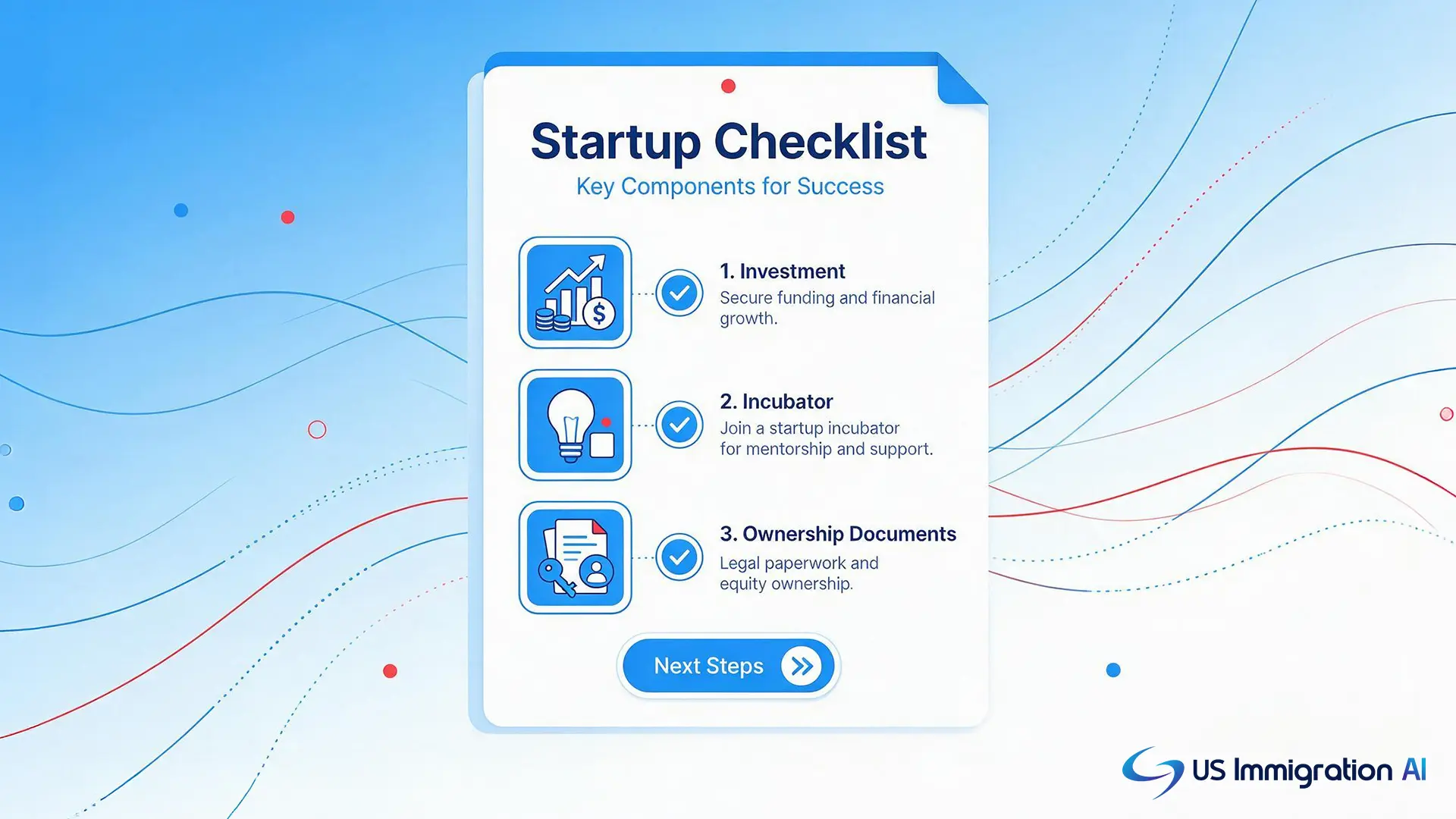
Because entrepreneurs don't follow a traditional career path, USCIS outlines evidence built specifically for them:
- Ownership and an active, central role in the U.S.-based company advancing the endeavor.
- Degrees, certificates, licenses, and letters documenting relevant experience.
- Investment from qualified third parties, such as venture capital or angel investors.
- Participation in a startup incubator or accelerator program.
- Awards, grants, or other government or industry recognition.
These map onto the same three prongs. Investment and incubator participation speak to Prong Two positioning, while awards and third-party interest can support Prong One's national importance. That entrepreneur-specific guidance didn't exist when Dhanasar was decided in 2016; it's part of a broader update USCIS made to the Policy Manual in 2025.
What the January 2025 Policy Update Changed
On January 15, 2025, USCIS issued Policy Alert PA-2025-03, updating the Policy Manual, Volume 6, Part F, Chapter 5. The update didn't change the three Dhanasar prongs. It sharpened how officers apply the threshold EB-2 analysis, and it added the entrepreneur-specific evidence and cautions described above.
Officers now give closer scrutiny to whether a petitioner's education and experience actually connect to the proposed endeavor, rather than accepting a general professional background as sufficient. The update applies to every NIW petition pending or filed on or after that date, which reaches cases that were already in the queue.
For your firm's practice, that shift matters most at the intake stage. A petitioner whose degree and work history don't map cleanly onto the proposed endeavor now needs that connection built out explicitly, not left implied. Getting the legal analysis right is only half the job; the other half is knowing how the petition actually moves through USCIS once it's filed.
Premium Processing and Filing Mechanics

NIW petitioners file Form I-140, Immigrant Petition for Alien Worker, on their own behalf. No employer sponsor or job offer is required, which is what makes the waiver valuable in the first place. The filing mechanics come down to a few key facts:
- Self-petition. No U.S. employer or job offer needed to file.
- Premium processing available. In place for EB-2 NIW petitions since January 30, 2023, on both new and previously filed I-140s.
- 45-business-day window. Slower than the standard 15-day track most other I-140 categories get; requested on Form I-907, Request for Premium Processing Service.
- Current fee: $2,965, effective March 1, 2026. This figure moves with periodic USCIS fee adjustments, so confirm it against the current USCIS fee schedule before filing.
Premium processing only speeds up the I-140 decision. It doesn't change the petitioner's priority date or move them faster through the Visa Bulletin. It matters most for a client who needs an approved I-140 to support a status extension, not one waiting on visa availability.
None of that timeline matters if the underlying evidence isn't organized before the petition is filed in the first place.
Tracking Evidence Across an EB-2 NIW Caseload
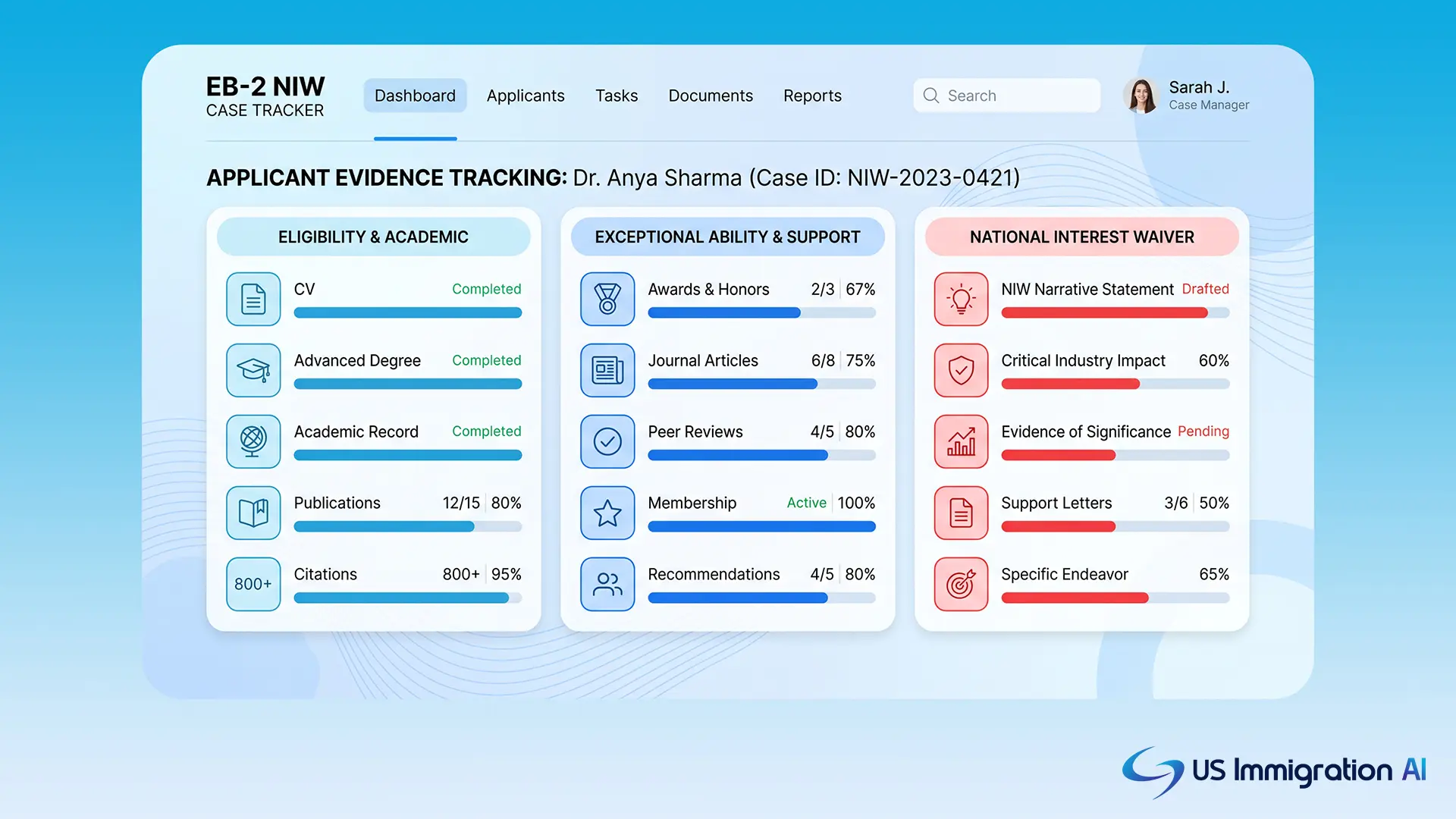
Each prong calls for its own body of evidence: publications and patents for merit, employment history and credentials for positioning, and a distinct narrative argument for the balance prong. Building all three into one coherent petition, without losing evidence under the wrong prong, is where NIW cases take real preparation time.
A shared document portal keeps evidence for each prong organized as it comes in. Your paralegal can see at a glance which prong still needs support before the petition goes to the attorney for final review.
Organized evidence gets a petition filed on time. Whether it gets approved still comes down to the same three-prong analysis this article started with.
Where This Leaves NIW Petition Prep
Dhanasar gave self-petitioners a more workable standard than NYSDOT ever offered, but flexibility isn't the same as an easy bar to clear. Every prong still needs its own dedicated evidence, connected clearly to the others, and the January 2025 update means the EB-2 threshold now needs that same explicit connection.
Petitions that treat the three prongs as one general pitch tend to struggle. Petitions that address each prong on its own terms, with evidence built specifically for it, are the ones that hold up under review.
Grow Your Caseload With US Immigration AI
EB-2 NIW petitions demand more organized evidence than almost any other case type your firm files. US Immigration AI helps your team track evidence prong by prong, for every client, with a licensed attorney reviewing every file before it goes out. Schedule a demo to see how it fits your caseload.