
Texas is implementing new laws covering immigration enforcement and AI within the same 12-month window, and a firm that tracks only one side will miss real exposure on the other. Several of these laws touch the same case file.
An enforcement statute can change how a client gets arrested, while an AI statute can change what your firm is liable for in how it prepares that client's paperwork. This guide walks through both tracks in plain terms, in the order they are most likely to reach your desk, then shows where they overlap.
Key Takeaways
- Texas SB 4 makes illegal entry a state crime. A federal court has blocked the reentry and removal-order provisions, but the illegal-entry arrest provision took effect on May 15, 2026.
- Texas SB 8 requires sheriffs in counties with jails and populations over 100,000 to seek 287(g) agreements with ICE, with full compliance required by December 1, 2026.
- Texas SB 17 restricts real estate purchases by people and entities tied to China, Iran, North Korea, and Russia. It does not apply to U.S. citizens or lawful permanent residents.
- The Texas Responsible AI Governance Act (TRAIGA) took effect January 1, 2026, and applies to any business using AI, including firms that use AI-powered case management tools.
- Three narrower 2025 laws (SB 441, HB 783, HB 3133) create new civil and criminal exposure around AI-generated deepfakes and online impersonation.
Start With the Track That Changes How Clients Get Arrested
Three Texas laws now shape how a noncitizen can be stopped, arrested, or screened inside the state. They did not all take effect on the same date, and one is still only partly in force, so it helps to take them in the order a case is most likely to hit them.
Texas SB 4: Illegal Entry Enforcement Is Live, Reentry Is Not
Senate Bill 4, signed in December 2023, created a new state crime for entering Texas outside a lawful port of entry and authorized state magistrates to order removal to Mexico, according to the enrolled bill text on file with the Texas Legislature. The law has moved in and out of effect through repeated litigation ever since.
The most recent turn came in May 2026. The ACLU of Texas and the Texas Civil Rights Project filed a new class action, LML v. Martin, seeking to block four provisions before the law's May 15 effective date.
A federal judge granted a preliminary injunction blocking the reentry crime and the state-ordered removal provisions, as The Texas Tribune reported. The provision letting police arrest someone for a first-offense illegal entry was not part of that injunction. It took effect as scheduled.
For your practice, this means:
- State and local police can now arrest a person on suspicion of illegal entry into Texas.
- A state arrest under SB 4 is likely to trigger an ICE detainer and a parallel federal removal proceeding. Removal defense counsel should expect to coordinate with criminal defense counsel from the first court appearance.
- The reentry crime and the magistrate-ordered removal process remain blocked while LML v. Martin proceeds. Clients cannot currently be ordered back across the border under this law.
Advise clients, including asylum seekers, parolees, and anyone with a pending application, to carry proof of lawful presence or a pending filing whenever they travel within Texas. Tell them to say nothing and sign nothing at a stop without a lawyer present.
Texas SB 8: Sheriffs Now Have to Ask ICE for a 287(g) Agreement
An arrest is only the first exposure point. What happens once a client reaches a county jail changed too.
Senate Bill 8 requires the sheriff of any Texas county with a jail and a population of 100,000 or more to request a written 287(g) agreement with ICE. Smaller counties may request one voluntarily.
The law took effect September 1, 2025. Full compliance is required by December 1, 2026, according to the enrolled bill text on file with the Texas Legislature.
A 287(g) agreement lets trained local officers perform certain federal immigration functions, most often checking immigration status of people already booked into jail. As of early 2026, Texas already had 299 active 287(g) agreements across 186 counties.
That means a client booked on an unrelated local charge is increasingly likely to be screened for immigration status before that charge is even resolved.
Build this into your intake screening. Ask every new client whether they have any pending local charges, not only immigration history, since a minor local arrest in a covered county can now become the trigger for a federal case.
Texas SB 17: A Property Law, Not an Immigration Status Law
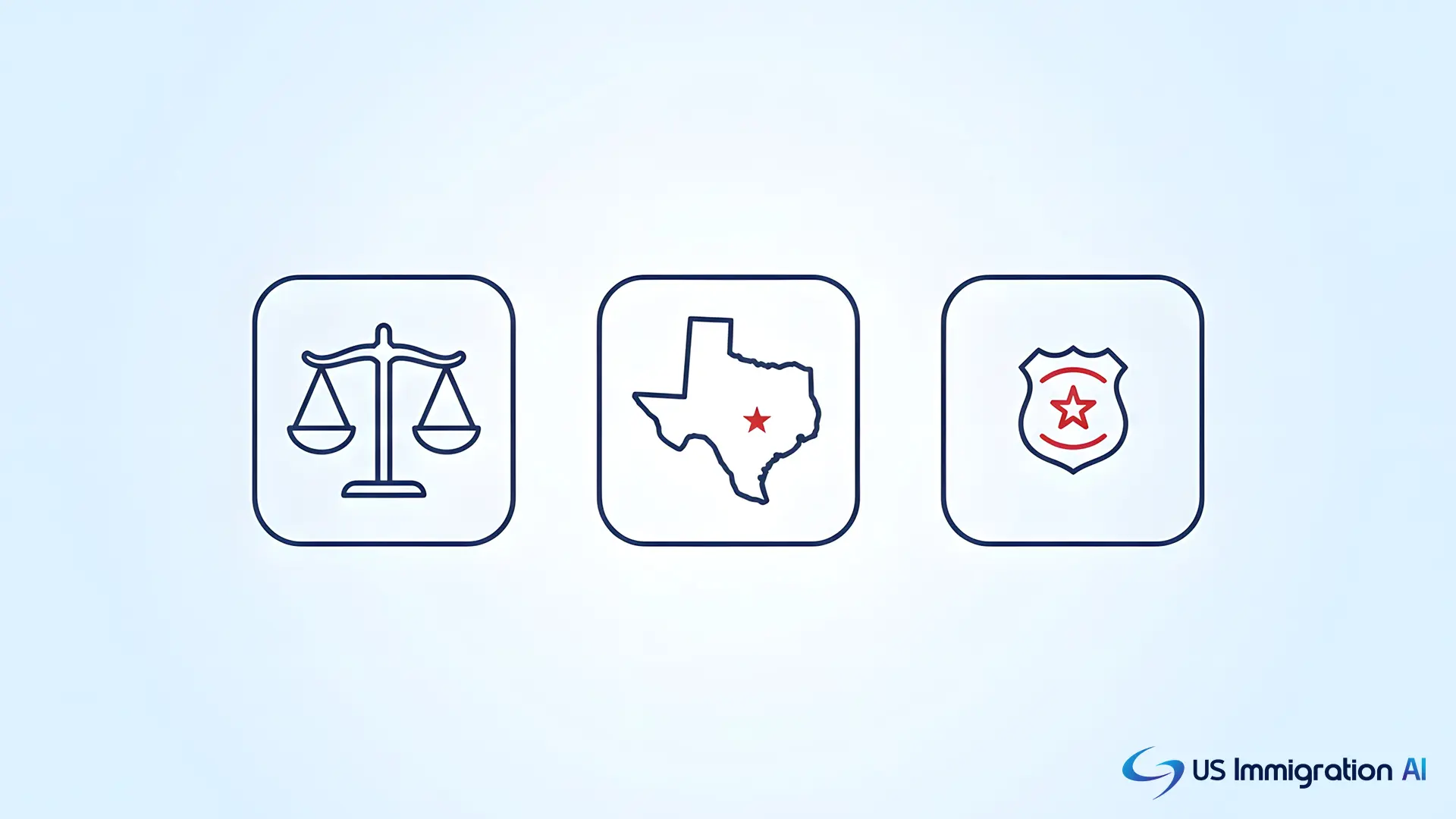
The same legislative session also produced a law that gets confused with immigration status, though it works on a different axis entirely. Senate Bill 17 took effect September 1, 2025.
It restricts real property purchases in Texas by individuals and entities connected to countries the U.S. Director of National Intelligence has designated as national security risks, currently China, Iran, North Korea, and Russia. The restriction covers residential, commercial, agricultural, and mineral property interests, per an analysis from Greenberg Traurig.
Two points matter for immigration practice specifically:
- SB 17 exempts U.S. citizens and lawful permanent residents outright, regardless of national origin. It is a national-security property statute tied to citizenship of a designated country, not a general restriction on immigrants.
- Real estate attorneys and business-immigration practitioners should still confirm a client's citizenship and residency status before any property purchase closes, since the designated-country list can expand by governor's action.
If your firm handles investor visas or corporate immigration work tied to property acquisition, flag SB 17 in the initial consultation so clients understand it separately from their immigration case.
The Second Track: How Texas Now Regulates AI Itself
That covers how Texas polices immigration status. The second track has nothing to do with a client's status and everything to do with how your firm, or any business, builds or uses AI, including the software running your intake, drafting, and case management.
The Texas Responsible AI Governance Act: What Applies to Your Firm
The Texas Responsible AI Governance Act, known as TRAIGA, took effect January 1, 2026. It does not single out law firms.
Instead, it applies broadly to businesses that develop or deploy AI systems used by people in Texas, which includes firms running AI-powered intake, drafting, or case management tools, per an overview from Baker Botts.
TRAIGA is intent-based rather than impact-based. It prohibits developing or deploying AI with the intent to unlawfully discriminate, manipulate someone into self-harm or criminal activity, infringe constitutional rights, or produce child sexual abuse material or unlawful deepfakes.
A 2025 American Bar Association overview notes that the statute expressly states that disparate impact alone does not establish intent to discriminate. That is a lower bar for a firm to clear than impact-based AI frameworks in other states.
Enforcement sits solely with the Texas Attorney General, and there is no private right of action. A business that receives a notice of violation has 60 days to cure it before the Attorney General can pursue a civil action.
Civil penalties run from $10,000 to $12,000 per curable violation and $80,000 to $200,000 per uncurable violation, with continuing violations adding up to $40,000 per day, according to an analysis from Jackson Walker.
TRAIGA also builds in a safe harbor. A company that substantially complies with the NIST AI Risk Management Framework, or that discovers and corrects a violation through its own testing, has an affirmative defense against liability under the statute, as detailed by Norton Rose Fulbright.
For a firm that already reviews AI-generated legal drafts before they leave the building, that habit lines up well with what the safe harbor rewards.

Deepfakes and Online Impersonation: New Civil Exposure to Know About
TRAIGA is not the only AI law from the same legislative session. Three narrower bills round out the picture, and each creates civil exposure worth knowing about even if your firm never touches the underlying conduct. Jackson Walker's summary of the session covers all three:
- Senate Bill 441, effective September 1, 2025, expands criminal and civil liability for creating or distributing nonconsensual, AI-generated intimate images, and extends liability to websites and payment processors that knowingly profit from hosting the material.
- House Bill 783, also effective September 1, 2025, creates a new civil cause of action for online impersonation, commonly called catfishing, where someone uses a person's name, voice, or likeness without consent and with intent to harm, defraud, intimidate, or threaten them.
- House Bill 3133, effective the same date, requires social media platforms to give users a way to report explicit deepfake content, acknowledge the report within 48 hours, and resolve it within seven days, per the bill's official analysis on file with the Texas Legislature.
None of these bills target legal practice directly, but immigration clients are frequent targets of impersonation scams, including fake attorney profiles and fraudulent visa consultants operating under a stolen identity. Knowing that HB 783 now gives a victim a real civil remedy is worth mentioning to clients who report this kind of fraud.
If Your Firm Uses AI in Immigration Court Filings
The AI laws above regulate your firm as a business. One more question sits closer to the casework itself: what happens when your attorneys use AI to help prepare a filing.
The Executive Office for Immigration Review issued Policy Memorandum PM 25-40, effective August 8, 2025. EOIR does not ban generative AI in filings and does not require disclosure of its use.
It does warn that attorneys who submit hallucinated or inaccurate AI content likely violate their professional conduct obligations. Individual immigration judges may still adopt their own standing orders on AI use.
The American Bar Association's Formal Opinion 512, issued July 29, 2024, covers the same ground at the professional-responsibility level. Lawyers using generative AI must still meet their duties of competence, confidentiality, and candor to the tribunal. They cannot outsource that judgment to the tool.
Read together, the message from both the agency and the bar is the same. AI can help prepare a filing, but a licensed attorney has to verify what it produced before it goes anywhere near a court.
That is the same principle behind attorney-reviewed AI legal drafting. The software fills out the form and drafts the letter. A human lawyer signs off before anything is filed.
Texas' New Laws at a Glance
With both tracks covered, here is how the effective dates, enforcement bodies, and requirements line up side by side.
Where This Leaves Immigration Practices
Neither track is finished moving. SB 4's reentry provisions are still in litigation, TRAIGA's Attorney General guidance is still developing, and the designated-country list under SB 17 can grow by governor's action.
Build a standing quarterly review into your compliance calendar rather than treating this as a one-time read. Assign one attorney to watch the enforcement docket and one to watch AI Attorney General guidance, and have both report to the managing partner at the same meeting.
Keep Your Firm Ready for Both Fronts
US Immigration AI runs intake, drafting, and case assembly on a platform built for immigration practice. A licensed attorney reviews every output before it leaves the system, the same standard EOIR and the ABA expect. Book a consultation to see how it fits your firm.
Frequently Asked Questions