
AI improves the accuracy of immigration form submissions by catching the mistakes that used to slip through: mismatched names across documents, missing fields, and outdated form editions. USCIS has gotten less forgiving of these mistakes, too. It can reject a filing over an outdated form edition, deny one over an invalid signature and keep the fee, or reject an entire multi-form package over a payment error, often with no chance to fix it first.
This guide breaks down why these errors happen, exactly what AI catches, what it flags for a human to check, and what still needs an attorney's judgment.
Key Takeaways
- USCIS can reject a filing over an outdated form edition, deny one over an invalid signature and keep the fee, or reject an entire package over a payment mistake, often with no chance to fix it first.
- Immigration cases mix clean government documents with inconsistent, foreign-issued, or handwritten ones, which is exactly where manual entry breaks down.
- AI reads client documents, pulls out names and dates, and reuses them across every form in a case.
- Every case of the same type runs through the same fixed checklist, so accuracy does not depend on which staff member is working it.
- The software cross-checks details between documents and flags anything that does not match, then routes anything it is unsure about to a person.
- An attorney still reviews every filing. AI narrows down what needs a closer look; it does not decide what is legally correct.
Why Filing Accuracy Matters More Than Ever
USCIS has moved toward stricter, less forgiving intake on three fronts: form editions, signatures, and payments.
Outdated Form Editions
Form editions change often, and filing an outdated one can mean an automatic rejection with no chance to fix it first. USCIS stopped accepting the prior edition of Form I-129 on February 27, 2026, and stopped accepting the prior edition of Form I-765 on March 5, 2026, according to the agency's Forms Updates page.
Invalid Signatures
Signatures now carry a sharper risk than a simple rejection. A Department of Homeland Security rule effective July 10, 2026 lets USCIS deny a filing over an invalid signature and keep the filing fee, instead of rejecting it with a chance to fix the mistake. See the Federal Register notice on signature requirements.
Combined or Mismatched Payments
USCIS requires a separate payment for each form in a multi-form package, and a single combined payment can get the entire package rejected, according to the agency's Filing Fees page.
None of this means a firm needs to slow down. It means the small errors that used to be a minor delay can now cost a filing fee and weeks of lost time, and that is the problem AI-assisted accuracy checks are built to solve.
Why Immigration Filings Are Especially Prone to Small Errors
Not every document a firm handles is equally easy to read, by a person or by software. Every case draws from a mix of document types, each carrying a different level of risk:
- Clean government documents. A U.S. passport or a driver's license follows the same layout every time, which makes it easy to read accurately.
- Foreign-issued documents. A birth certificate or an employer's support letter follows a format that varies from issuer to issuer.
- Free-form documents. Personal statements, handwritten notes, and letters with no fixed layout at all are the hardest to read correctly, by a person or by software.
A single immigration case usually includes documents from all three groups, often in more than one language. This is why the same client's name can appear one way on a passport and another way on a birth certificate, through translation, transliteration, or a simple clerical difference. It is also why a case built entirely by hand is more likely to carry that mismatch all the way to a filing without anyone catching it.
How AI Reads and Pulls Information From Your Client's Documents
AI reads a passport, green card, or birth certificate the way a paralegal would, by scanning the page and pulling out the names, dates, and numbers it needs. It then places those details into the matching fields on a form.
This matters most on cases with many forms, since a client's details often need to appear on a petition, a supporting application, and a cover letter. Entering the information once and reusing it removes the retyping that causes small errors to creep in. That reuse only helps if it happens the same way on every case, which is where a firm's process matters as much as the software.
Running the Same Accurate Checklist on Every Case
A firm that tracks its process from memory or a shared spreadsheet is one staff turnover away from a missed step. AI-assisted workflows fix each case type to the same sequence, so an I-130 case, an N-400 case, and an H-1B petition each run through the same defined checks every time.
This consistency is its own accuracy safeguard. A new hire working an I-130 case follows the same steps a ten-year paralegal would, instead of reconstructing the process from memory or from whatever the last case happened to need. The checks in the next two sections, matching details across documents and flagging anything uncertain, run inside that same sequence every time, rather than depending on someone remembering to run them.
Catching Mismatches Before They Reach USCIS
A name that appears one way on a passport and another way on a birth certificate is one of the most common causes of a Request for Evidence. AI checks a client's details across every document in the case and flags it the moment two sources disagree.
A marriage-based green card case shows this well. That filing usually includes three forms in the same packet:
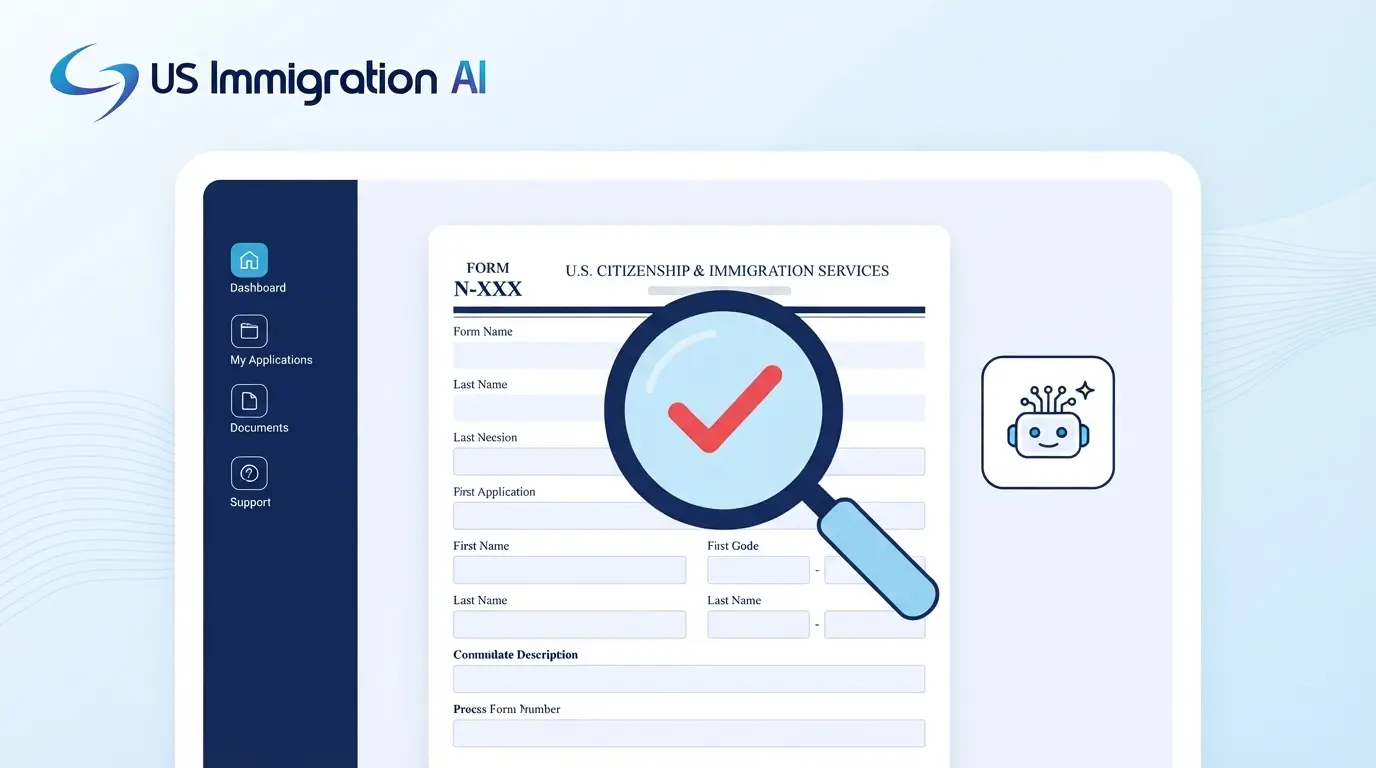
AI compares the same client's name, date of birth, and country of citizenship across all three forms, and flags it the moment one form disagrees with another, before an officer ever sees the inconsistency. The same check runs on addresses and identification numbers, and it flags a required field left blank before the filing goes out the door.
Flagging What the Software Is Not Sure About
AI does not treat every extraction as equally reliable. When it pulls a detail from a blurry scan or an unusual document format, it can flag that entry as uncertain instead of filing it as fact.
That flag routes the field to a person for a second look. A firm that only reviews the flagged fields, rather than rereading an entire packet line by line, saves real time without giving up the check that catches a bad extraction.
The correction does not stop at that one case. When a person fixes a flagged field, that correction can inform how the software reads similar documents on the next case, so a document format that caused a flag once is less likely to cause the same flag repeatedly.
The software narrows down what needs a closer look. It does not decide what the correct answer is. Firms that want the full picture can read how they keep attorney oversight over every AI-assisted filing.
Keeping Every Form on the Current Edition
A correct form on an outdated edition can still be rejected. USCIS updates form editions on a rolling basis, sometimes with no grace period once the change takes effect.
AI-assisted drafting tools can check a form against the currently accepted edition before it goes into a filing, rather than relying on someone remembering to check uscis.gov that same week. Firms that want the full, current list of forms by case type can see the complete list of immigration forms and what changed in 2026.
What AI Still Cannot Catch
AI checks facts against each other. It cannot judge whether a case is strong, whether an argument will persuade an officer, or whether the evidence meets a legal standard.
A national-interest waiver petition shows the limit clearly. Every form can be filled correctly and every fact cross-checked, and the petition can still fail if the evidence does not meet the three-prong framework set out in Matter of Dhanasar. AI has no way to weigh whether the evidence clears that standard. That judgment call stays with the attorney, and accuracy tools only get the paperwork ready for the attorney to make it.
Build Accuracy Into Every Filing With US Immigration AI
US Immigration AI reads your client's intake data, fills the matching USCIS forms, and flags anything that needs a second look before your team files. A licensed attorney reviews every file before submission. Schedule a walkthrough to see it on your own case types.