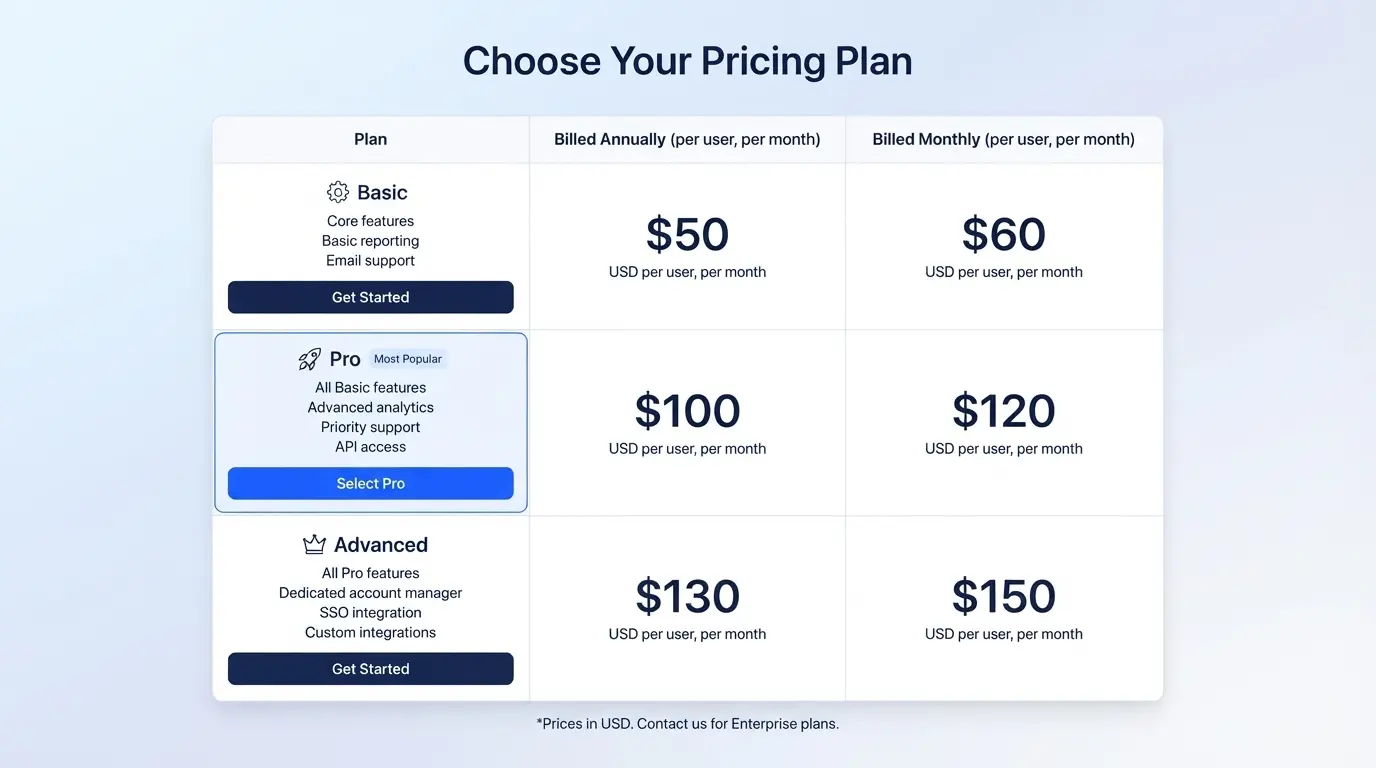

MyCase pricing is built on three plans, Basic, Pro and Advanced, each charged per user per month. Annual billing brings Basic to $50, Pro to $100 and Advanced to $130 per user per month, according to MyCase's pricing page.
Not every MyCase page agrees on those figures. This guide shows where the numbers differ and how to turn a per-user price into a cost per case. US Immigration AI sells a different product, and the plan details below come from MyCase's own pages.
Prices on this page were checked on October 28, 2026.
Key Takeaways
- As of October 28, 2026, MyCase's three per-user plans cost $50, $100 and $130 billed annually.
- Some MyCase pages still print $39, $89 and $109, so treat the pricing page as the source of record.
- Intake forms and the legal CRM start in Pro, not Basic.
- MyCase Accounting adds $39 per user per month, while processing fees and the immigration add-on are priced separately.
- Dividing the yearly cost by cases opened lets you compare a per-user price with a per-application price.
What MyCase Is and How Its Plans Work
Law firms use MyCase to run a practice, from case records and billing to client communication, with immigration tools sold as an add-on. A firm can keep cases and contacts in one place, track time, send invoices and take online payments. Documents reach clients through a portal.
Plans come in three levels: Basic, Pro and Advanced. Pro includes everything in Basic, and Advanced includes everything in Pro. Each step up adds tools and removes none.
Every plan is charged per user per month, so the total depends on the number of users as well as the plan. According to MyCase's pricing page, the rate follows active firm users and annual billing saves up to 16%. The support center adds that clients with portal access are never charged and that there is no setup fee.
MyCase Plans and Monthly Prices
With the plan structure clear, the next question is what each plan costs. The table lists each plan's price as shown on MyCase's pricing page on the check date above.
New accounts get a 10-day free trial, and MyCase says no credit card is needed. Before you rely on the table, check how well the published sources agree.
Why Published MyCase Prices Disagree
That table is only as reliable as its source, because MyCase's own pages do not all agree. The table below lists what four other pages printed as of October 28, 2026, for annual billing, against the pricing page's $50, $100 and $130.
Treat the pricing page as the source of record, and compare the same billing period, since annual and monthly prices differ on every plan. Write down the date as well, because MyCase can change its prices at any time. With one confirmed set of prices, the next question is what each plan includes.
What Each MyCase Plan Includes
The price gap between plans buys added tools. Each feature list below comes from MyCase's pricing page.
Basic
Basic covers the daily work of a small practice: case and contact management, time entry, invoicing, trust accounting and online payments with next-day deposits. It also has customizable reporting, unlimited document storage and a limited client portal.
Pro
Pro includes everything in Basic and adds the tools that bring clients in and keep them informed:
- client intake forms and a legal CRM (a tool that tracks leads and client contacts)
- two-way texting, chat and call logging
- automated workflows and unlimited eSignature
- premium billing and reporting
- a writing and document assistant
- more than 70 integrations
Advanced
Advanced includes everything in Pro and adds:
- conflict check tracking and split billing
- an open API and advanced document automation
- a desktop drive for PC and Mac
- AI assistants for cases and discovery documents
Teams that want online intake should price Pro first. Even then, the plan price is only part of the monthly bill.
Costs Outside the Plan Price
Several costs sit outside the plan price. The table shows what MyCase's pricing page, support center and announcements say about each, as of October 28, 2026. Some rows carry a published price and some do not.
Processing fees grow with the dollars a firm collects. MyCase's pricing page lists no processing rate, so ask whether LawPay's standard rates apply to your account.
Firms that collect most retainers by card should estimate processing from their yearly payment total. Card volume changes from month to month, so last year's collections make a fair starting estimate. With those figures in hand, you can turn them into a cost per case.
How to Calculate MyCase's Cost per Case
Per-user prices become comparable across tools once you divide by the cases your firm opens each year. Multiply the number of users by the monthly price and by 12, add any add-ons, then divide by cases opened in a year. Use the case count from your own records, not a forecast.
This table shows the math at $100 per user per month, the annual price of the Pro plan. Swap in the price of the plan you are pricing.
Cost per case falls when each user handles more cases, and it rises when added seats do not bring added cases. Per-user add-ons multiply by headcount like the plan price, so add them before you divide.
What MyCase Pricing Means for an Immigration Firm
Once the math is in place, the question for an immigration firm is what MyCase adds for that work. MyCase's comparison page does not mention immigration, but MyCase announced an immigration add-on in October 2024. The announcement lists smart forms that fill in client data, USCIS case tracking and priority date tracking.
It also covers e-filing to USCIS, the Department of Labor (FLAG) and the State Department (CEAC), but the announcement gives no price. Ask MyCase what the add-on costs per user and which plans can buy it. Put that answer into the cost-per-case table above, and ask whether paralegals who only prepare forms need paid seats.
US Immigration AI prices a different way: $97 per application, or $997 per month for the all-in-one plan. See how the platform works for the immigration side, and compare what each product includes before you compare price. For the wider category, read our guides to what immigration case management software is and the best immigration case management software.
When Per-User Pricing Fits and When It Does Not
Which model suits your firm is the remaining question. Per-application prices follow case volume, while per-user prices follow headcount. A stable team doing general practice work fits per-user pricing, because the bill stays flat while case counts swing. Uneven case volume or many part-time reviewers can favor a per-application or flat monthly model.
To test it, divide your monthly software total by the price per application. The result is the number of applications a month at which the two models cost the same. Five users at $100 each come to $500 a month, which equals about five applications at $97.
Grow Your Caseload With US Immigration AI
If you want a price that follows case volume, US Immigration AI handles intake, retainers, document collection, drafting and case assembly. An attorney reviews every file before filing. Book a consultation to see how that fits your caseload.
Frequently Asked Questions