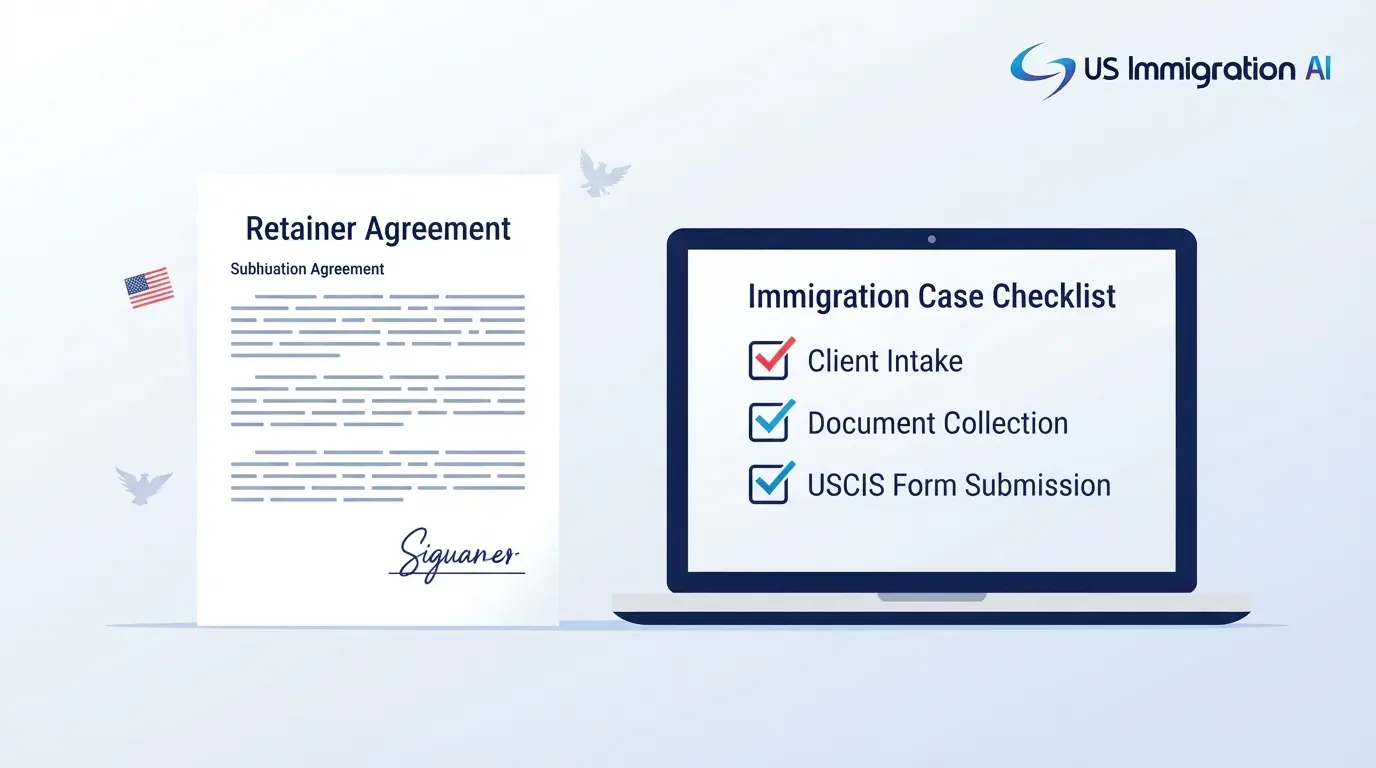

This AI immigration retainer agreement template for law firms covers the terms every immigration retainer needs and the AI terms most templates leave out. The post starts with the basics and works up to appearance forms, consent for AI tools, billing, and clients who use public chatbots.
Consider a firm that signed a client in January and added an AI drafting tool in March. The January retainer says nothing about the tool, yet the client's passport, tax records, and immigration history now pass through the firm's workflow.
The ABA, California, and Texas have each addressed whether and how to tell the client. The sections below cover what they say.
Key Takeaways
- The scope clause and the appearance form must match. Filing an EOIR-28 makes the firm the practitioner of record until an immigration judge permits withdrawal, so the termination clause should say the firm will move to withdraw.
- ABA Formal Opinion 512 says boilerplate in an engagement agreement is not enough when a tool handles client information. Name the tool category and the data it touches, with separate consent for tools that read client documents.
- Say in the retainer how AI affects the bill. General AI subscriptions are overhead, and per-use charges must be disclosed, billed at actual cost, and carry no markup without the client's written consent.
- Add a clause telling clients to ask before putting case facts into public chatbots. United States v. Heppner held that a defendant's exchanges with a consumer AI tool were not privileged
What an Immigration Retainer Agreement Has to Do
An immigration retainer agreement is the written contract that fixes the scope of the work, the fee, and each side's duties before the firm starts. Four rules set the baseline:
- ABA Model Rule 1.5(b) requires the lawyer to communicate the scope and the basis or rate of the fee, preferably in writing, before or within a reasonable time after the work begins.
- Model Rule 1.2(c) lets a lawyer limit the scope only if the limit is reasonable and the client gives informed consent.
- New York's letter-of-engagement rule, 22 NYCRR 1215.1, requires a written letter or signed retainer. It must explain the scope, the fees, expenses and billing practices, and, where applicable, the client's right to arbitrate fee disputes. The rule has exceptions, including an expected fee under $3,000.
- California Business and Professions Code section 6148 requires a written contract when the total expense to the client will reasonably exceed $1,000. A noncompliant agreement is voidable at the client's option.
Fees add a second layer in immigration practice. An AILA blog post notes that virtually every case immigration lawyers take is handled on a flat fee, so the written terms around that fee carry extra weight.
The Core Clauses, in Order
A retainer reads best when its parts follow the life of the matter, from engagement to file closing. A workable order is:
- The parties and the specific matter, such as a joint I-130 and I-485 filing for a named couple.
- The scope, including what is excluded, such as appeals, motions to reopen, and later petitions.
- The fee, the payment schedule, and the costs the client pays separately, such as government filing fees.
- What the client must do, including accurate answers, timely documents, and notice of address changes.
- Which appearance form the firm will file and what it authorizes.
- How either side ends the engagement and what happens to unearned money.
- How long the firm keeps the file and how the client can get a copy.
Language belongs in this list too. Under 8 CFR 1003.102(r), a practitioner before EOIR must take reasonable steps to communicate with the client in a language the client understands. Giving the client the retainer in that language from the start meets the duty and makes any later AI consent easier to defend as informed.
Firms that automate retainer signing, including through the AI Retainer solution from US Immigration AI, need the same clauses in the document being signed.
How Retainer Scope Meets the Appearance Forms
Filing an appearance form puts the firm on record with the agency or court, so the retainer scope and the form have to match. The form depends on where the matter is pending.
Termination and Withdrawal
A practitioner who has filed an EOIR-28 stays the practitioner of record unless an immigration judge permits withdrawal or substitution on motion.
The termination clause therefore cannot end the firm's obligations on the day the client stops paying. It can say that the firm will move to withdraw and that the judge decides. A document-only retainer built on the EOIR-61 should say plainly that the client remains unrepresented.
Duties After the Final Decision
Scope also carries duties past the final decision. Under 8 CFR 1003.102(q)(3):
- A practitioner carries a matter through to its conclusion consistent with the agreed scope, unless the client terminates or the practitioner obtains permission to withdraw.
- If the result is adverse and the parties never agreed on an appeal, the practitioner must consult the client about appeal rights and the terms of possible representation.
A retainer that excludes appeals should say so and promise that consultation.
Flat Fees, Advance Payments, and Refunds
Once the scope is fixed, the fee clause has to say when the money is earned. State rules differ, so the retainer should state where advance payments sit. Two examples show the range:
- In In re Mance (D.C. 2009), the court held that a flat fee paid by a client remains the client's property until the work is done, unless the client agreed otherwise. The AILA blog post discussing the case notes that its facts were not immigration related.
- Colorado Rule 1.5(h) requires flat fee terms in writing. A Colorado Bar Association article lists the contents: the services and scope, the amount and timing of payment, any amount earned at set milestones, and how any fee is calculated if the representation ends early.
A federal layer sits on top of state rules. EOIR can discipline an attorney for a fee that is grossly excessive under 8 CFR 1003.102(a)(1). The regulation lists the factors, including the time and labor required, the difficulty of the questions, the customary local fee, the results obtained, and the experience of the attorney.
A flat-fee clause that holds up under those rules names what the fee covers and ties payments to milestones the client can recognize. It also states what is refundable if the matter ends early. Check your own state's rule on trust accounts before choosing a payment schedule.
Why a Single AI Consent Sentence Falls Short
Everything above holds whether or not a firm uses AI. The question changes when a tool starts handling client information, because a general "we may use AI" sentence does not secure informed consent. ABA Formal Opinion 512, issued July 29, 2024, is the national starting point.
The Minnesota Office of Lawyers Professional Responsibility summarizes it this way: many generative AI tools will generally call for the client's informed consent, and informed consent means explaining the information with particularity. Boilerplate in an engagement agreement is not enough. The opinion also says lawyers sometimes must disclose AI use even when the client has not asked.
What State Guidance Adds
States add their own guidance:
- Texas Opinion 705 (February 1, 2025) says a lawyer who intends to use confidential information with generative AI should consider informing clients of the risks and may need their consent.
- The State Bar of California's Board of Trustees approved updated Practical Guidance on May 14, 2026. It says an attorney must consider disclosing the intended AI use, including how it will be used and its benefits and risks. It also says the attorney must follow client instructions that restrict AI use.
- California SB 574, signed September 30, 2026 as Chapter 858, Statutes of 2026, adds Business and Professions Code section 6068.1 and takes effect January 1, 2027. It bars an attorney from entering confidential, personal identifying, or other nonpublic information into a generative AI system. The exception is a system where access is restricted to the attorney and authorized persons bound to protect it. The statute's list of personal identifying information includes dates of birth, Social Security numbers, and financial information, all of which appear in many immigration intake packets.
What This Means for the Retainer
These sources support a layered retainer. A short base clause covers every client, and a specific consent covers each use that involves client data. Per-use consent also gives the firm a clear answer when a client asks what happens to a passport scan.
Three AI Clauses for Three Levels of Data Exposure
The layers differ in how much client information the tool sees, so each needs its own wording. Include only the clauses your firm uses, and name the tool category and the data involved so the client can see what they are agreeing to.
Drafting and Research Support
This clause fits firms whose tools work from firm templates and public legal sources, with no client information entered. It states that AI helps with drafting and research, that an attorney reviews the work, and that the firm stays responsible for it. Because no client data goes in, it needs notice but not a separate initialed consent.
AI That Reads Client Documents
This clause fits tools that read passports, civil records, tax returns, or case histories and pull out names, dates, and other facts. It needs the most detail. The clause should:
- Name the kind of tool, such as a business-grade account whose written terms restrict the provider's use of client data.
- State who inside the firm can access the information.
- Say that free public tools are not used.
- Let the client decline, and promise that an attorney will do those tasks without AI if the client does.
A per-use consent line the client initials is useful here, but a checkbox does not by itself establish informed consent. Pair it with a conversation and a note in the file recording what was explained.
AI in Intake and Client Communication
This clause fits tools that talk to prospective clients, answer routine questions, or send updates. California's 2026 guidance lists autonomously facilitating client intake as an example of agentic AI.
It says attorneys must not let such a system communicate legal advice, prepare and file pleadings, or act in a representative capacity without meaningful attorney supervision and review.
The clause should say that the tool collects facts and does not give legal advice. It should also say that an attorney reviews the intake before advising and that the client can reach a person at any time.
Firms that run intake through software, such as the AI Intake solution from US Immigration AI, can attach this clause to that step.
Billing Language for AI-Assisted Work
Each of these tools has a cost, and the retainer should say who bears it. Hourly billing must reflect the time actually spent, so efficiency gained from AI belongs to the client. The table below summarizes how California's 2026 guidance and Opinion 512 (as the Minnesota summary describes it) treat each charge.
For flat fees, the guidance adds two points:
- Flat fees suit predictable work, with the expected time savings built into the rate.
- Fee agreements should explain how AI factors into the fee.
Opinion 512 requires that any charge for AI tools be explained at the start of the representation, preferably in writing. Immigration firms on flat fees can keep this short: state that the fee covers the firm's tools, and promise written notice before any per-use charge.
A Clause for Clients Who Use Public AI Tools
The firm controls its own tools, but not what a client types into a public chatbot. In United States v. Heppner, No. 25-cr-00503 (S.D.N.Y. Feb. 17, 2026), Judge Rakoff held that a criminal defendant's exchanges with a consumer AI tool were neither privileged nor protected work product. A Columbia Law School summary of the written opinion gives the reasons:
- The tool is not an attorney.
- The defendant used it "of his own volition" and not at counsel's direction.
- The provider's privacy policy left him no reasonable expectation of confidentiality.
- Sending the outputs to his lawyers afterward did not create privilege.
The ruling is narrower than some headlines suggested. It applied traditional privilege rules to one defendant's use of a free consumer tool, and the court said counsel-directed use might be analyzed differently.
It still gives immigration clients a practical warning, because declarations about a client's history sit at the center of many applications. A client-side clause tells clients four things:
- Conversations with public AI tools may not be confidential or privileged.
- Clients should ask the firm before putting case facts into one.
- If the firm directs a particular tool, it will say so in writing.
- The client must read and confirm the facts in any statement prepared for filing, whoever or whatever drafted the first version.
Attorney Review and the Immigration Court Rules
Whatever the client or the firm's tools produce, the attorney signs the filing. EOIR Policy Memorandum 25-40, issued August 8, 2025 by Acting Director Sirce E. Owen, says EOIR has no blanket prohibition on generative AI. It also says practitioners who submit hallucinated or erroneous AI-generated content in filings likely violate professional conduct obligations.
The memo cites several grounds in 8 CFR 1003.102, including:
- Paragraph (c), which covers knowingly or recklessly making a false statement of material fact or law and requires remedial measures when a practitioner learns offered evidence is false.
- Paragraph (o), which covers failing to provide competent representation.
- Paragraph (u), which covers repeatedly filing boilerplate that shows little attention to the client's facts.
What the Retainer Should Promise
The memo adds that attorneys may in some circumstances need to consult clients about AI use, and it cites Opinion 512. For the retainer, that supports three short commitments:
- AI never files or sends anything to an agency or court on its own.
- An attorney reads, edits, and signs every filing.
- The client confirms the facts in any statement made in their name before it is filed.
California's 2026 guidance takes the same line, saying attorneys must not let AI systems autonomously file documents or communicate with the court, and that no document goes to a court without attorney review and approval.
An Immigration Retainer Template With AI Clauses
The template below follows the order of this post. Replace the bracketed fields and delete the optional clauses your firm does not use. State rules on fee agreements, trust accounts, and AI disclosure differ, so have a licensed attorney in your state review the whole document before use.
IMMIGRATION LEGAL SERVICES AGREEMENT
- Parties and matter. This agreement is between [FIRM NAME] (the Firm) and [CLIENT NAME] (the Client) for [DESCRIBE THE MATTER, FOR EXAMPLE, A FORM I-130 AND FORM I-485 FILING].
- Scope. The Firm will [LIST SERVICES]. The Firm will not handle [LIST EXCLUSIONS, FOR EXAMPLE, APPEALS, MOTIONS TO REOPEN, OR LATER PETITIONS] unless the parties sign a new agreement. If the result is adverse, the Firm will consult the Client about appeal rights and the terms of any appeal representation.
- Appearance forms. The Firm will file [FORM G-28 / FORM EOIR-28 FOR ALL PROCEEDINGS / FORM EOIR-28 FOR CUSTODY AND BOND ONLY / FORM EOIR-28 FOR ALL PROCEEDINGS EXCEPT CUSTODY AND BOND / FORM EOIR-61 FOR DOCUMENT ASSISTANCE ONLY]. By signing the form, the Client authorizes the Firm to represent the Client. If the Firm files an EOIR-28, the Firm remains the Client's practitioner of record until the immigration judge permits withdrawal or substitution.
- Fees and costs. The Client will pay a [FLAT / HOURLY] fee of [AMOUNT] under this schedule: [PAYMENT SCHEDULE]. The fee is earned [WHEN, PER YOUR STATE RULE]. Government filing fees, translations, and courier costs are paid by the Client and are not part of the fee. If the matter ends early, the Firm will refund [DESCRIBE REFUND RULE] within [NUMBER] days.
- Client responsibilities. The Client will answer questions truthfully, provide documents on time, and tell the Firm about any change of address, contact details, or status within [NUMBER] days. The Firm will communicate with the Client in [LANGUAGE] and will provide a translation of this agreement on request.
- Use of AI by the Firm. The Firm may use AI tools to help draft documents and summarize public legal sources. The Firm does not enter the Client's personal information into these tools for that purpose. An attorney reviews and is responsible for all work product.
6A. (Optional) AI that reads the Client's documents. With the Client's consent, the Firm may use AI tools to read the Client's documents and pull out names, dates, and other facts for the Client's forms. The Firm uses only business-grade tools under written terms that restrict the provider's use of the Client's data, and only Firm personnel bound by confidentiality can access that information. The Firm does not use free public AI tools for the Client's documents. The Client may decline this use at any time, and an attorney will then handle those tasks without AI. Client's initials: ______
6B. (Optional) AI in intake and messaging. The Firm's intake and messaging tools may use AI to collect facts, schedule appointments, and send routine updates. These tools do not give legal advice. An attorney reviews the Client's intake information before advising the Client, and the Client may ask to speak with a person at any time. Client's initials: ______
- Fees for AI tools. The Firm's fee covers its use of AI tools. The Firm does not charge separately for AI subscriptions or for time spent learning a tool. If the Firm needs a per-use tool for the Client's matter, it will tell the Client in writing before charging, will charge only its actual cost, and will add no markup unless the Client agrees in writing.
- Review and filing. AI never files or sends anything to an agency or court on its own. An attorney reads, edits, and signs every filing. Before filing, the Client will review the facts in any statement made in the Client's name and confirm that they are true and complete.
- The Client's own use of AI tools. Conversations with public AI tools may not be confidential or privileged. The Client agrees to ask the Firm before entering case facts into such a tool. If the Firm directs the Client to use a particular tool, the Firm will say so in writing.
- Ending the agreement. Either party may end this agreement by written notice. If an appearance is on file in immigration court, the Firm will ask the immigration judge for permission to withdraw, and the judge decides.
- Files. The Firm will keep the Client's file for [NUMBER] years after the matter ends and will give the Client a copy on request.
Signed: ______ (Client) Date: ______ Signed: ______ (Attorney) Date: ______
Grow Your Caseload With US Immigration AI
US Immigration AI automates the immigration case lifecycle, from intake and retainer agreements to document collection, form drafting, and case assembly, with a licensed attorney reviewing every file. If you want to see how that fits your firm's workflow, schedule a demo.
Frequently Asked Questions