

ABA Formal Opinion 512 is the American Bar Association's July 29, 2024 guidance on how lawyers may use generative AI. It applies the existing Model Rules of Professional Conduct to tools such as chatbots and AI drafting software. The full text is in the ABA's published opinion.
The opinion is advisory, yet the Executive Office for Immigration Review (EOIR) cites it in its 2025 memo on AI. In 2026 the Ninth Circuit and the Board of Immigration Appeals both disciplined attorneys over AI-generated citations. This guide takes each duty in turn, then adds the immigration rules, recent cases and a firm policy starter.
Key Takeaways
- Opinion 512 is advisory guidance that applies six existing duties to generative AI: competence, confidentiality, communication, candor, supervision and fees.
- Every citation and quoted fact in an AI-assisted filing needs a human check, and EOIR's memo says filing hallucinated or erroneous AI content likely violates a practitioner's professional obligations.
- In 2026 the Ninth Circuit suspended two immigration attorneys over unverified AI-generated citations, and the BIA imposed reciprocal discipline on one of them.
- For self-learning AI tools, the opinion says client informed consent is required before client information goes in, and boilerplate in an engagement letter does not meet that standard.
- A written firm policy should cover staff, representatives and vendors, and hourly bills may reflect only the time actually spent.
What ABA Formal Opinion 512 Says and Whether It Binds Your Firm
Formal Opinion 512, titled Generative Artificial Intelligence Tools, came from the ABA Standing Committee on Ethics and Professional Responsibility on July 29, 2024. The ABA announced it as its first ethics guidance on a lawyer's use of AI tools. Its text offers general guidance on how the existing Model Rules apply to generative AI (Op. 512 at 2).
Because it is advisory, an ABA opinion is persuasive and not binding. A lawyer answers to the conduct rules of the state and tribunal where they practice. Your state bar's guidance and each court's rules therefore come first. Opinion 512 still matters because EOIR cites it, as covered below.
Six duties organize the opinion's guidance, and the table pairs each one with its Model Rule.
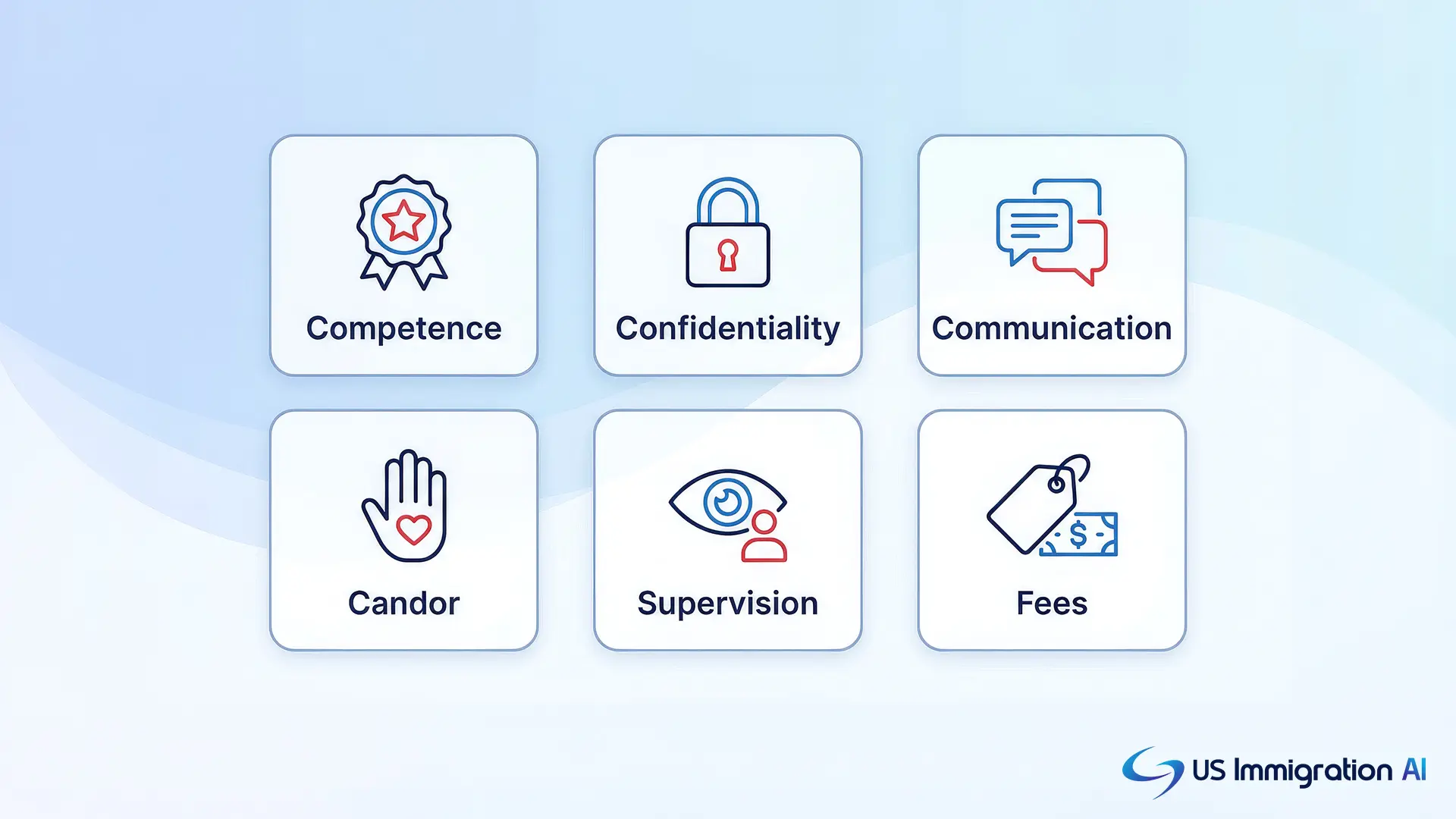
Competence (Model Rule 1.1): Understanding the Tool
Competence is the first duty the opinion covers, and it starts with knowing what a tool can and cannot do. Opinion 512 asks lawyers to have a reasonable understanding of a tool's capabilities and limitations (Op. 512 at 2-3). Lawyers need not become experts, but the duty is ongoing because the tools change quickly (Op. 512 at 3).
Relying on a tool's output without appropriate independent verification could violate Rule 1.1 (Op. 512 at 3-4). The right amount of review depends on the tool and the task. A lawyer who tested a tool on a small sample, for example, need not recheck every document it summarizes (Op. 512 at 4).
Judgment stays with the lawyer, who remains fully responsible for the work (Op. 512 at 4). The opinion says legal advice and the negotiation of a client's claims cannot be left to a tool alone.
Confidentiality (Model Rule 1.6): Consent When Files Hold A-Numbers and Passports
Knowing a tool's limits includes knowing what it does with the information typed into it. Rule 1.6 covers all information relating to the representation (Op. 512 at 6). Rules 1.9(c) and 1.18(b) extend the same protection to former and prospective clients, such as people who consult a firm first.
Before entering client information into a tool, a lawyer must evaluate who else could see it (Op. 512 at 6). That includes people outside the firm and colleagues inside it who are not meant to have the information. The analysis depends on the client, the matter, the task and the tool.
Self-learning tools raise a specific risk: one client's information can surface in answers to other users, even inside one firm (Op. 512 at 6-7). For that reason, the opinion says informed consent is required before client information goes into such a tool (Op. 512 at 7).
What Informed Consent Requires
For consent to be informed, the opinion says the client must have (Op. 512 at 7):
- the lawyer's best judgment about why the tool is being used
- an explanation of the extent of the information and the kinds of client information that will be disclosed
- the ways others might use the information against the client's interests
- a clear explanation of the tool's benefits to the representation
- an explanation of the risk that later users or beneficiaries of the tool will access the information
Adding general boilerplate to engagement letters is not sufficient (Op. 512 at 7). Consent is not needed when a lawyer uses a tool for idea generation without entering client information. As a baseline, lawyers should read a tool's terms of use and privacy policy, or consult someone who has (Op. 512 at 7).
A Data Table for Immigration Files
This table is a conservative starting point for firm policy and is not opinion text, so an attorney should adapt it to your state's rules.
Clients can upload passports and civil records in one place through a secure immigration client portal. Our guide to immigration software data security lists questions to put to any vendor.

Communication (Model Rule 1.4): Telling Clients About AI Use
Informed consent is one reason to tell a client about AI use, and Rule 1.4 adds others. The opinion says the facts of each case decide whether AI use must be disclosed, and sometimes disclosure is unnecessary (Op. 512 at 8). It lists situations where lawyers must tell clients (Op. 512 at 8-9):
- Client information will go into a tool, which calls for informed consent first.
- The client asks how the lawyer did the work, or whether AI was used.
- The engagement agreement or the client's outside counsel guidelines require disclosure.
- AI use is relevant to the basis or reasonableness of the fee.
- The tool's output will influence a significant decision, such as evaluating litigation outcomes or selecting a jury.
- The client hired the lawyer for particular skill and judgment, and undisclosed AI use would break the engagement terms or the client's reasonable expectations.
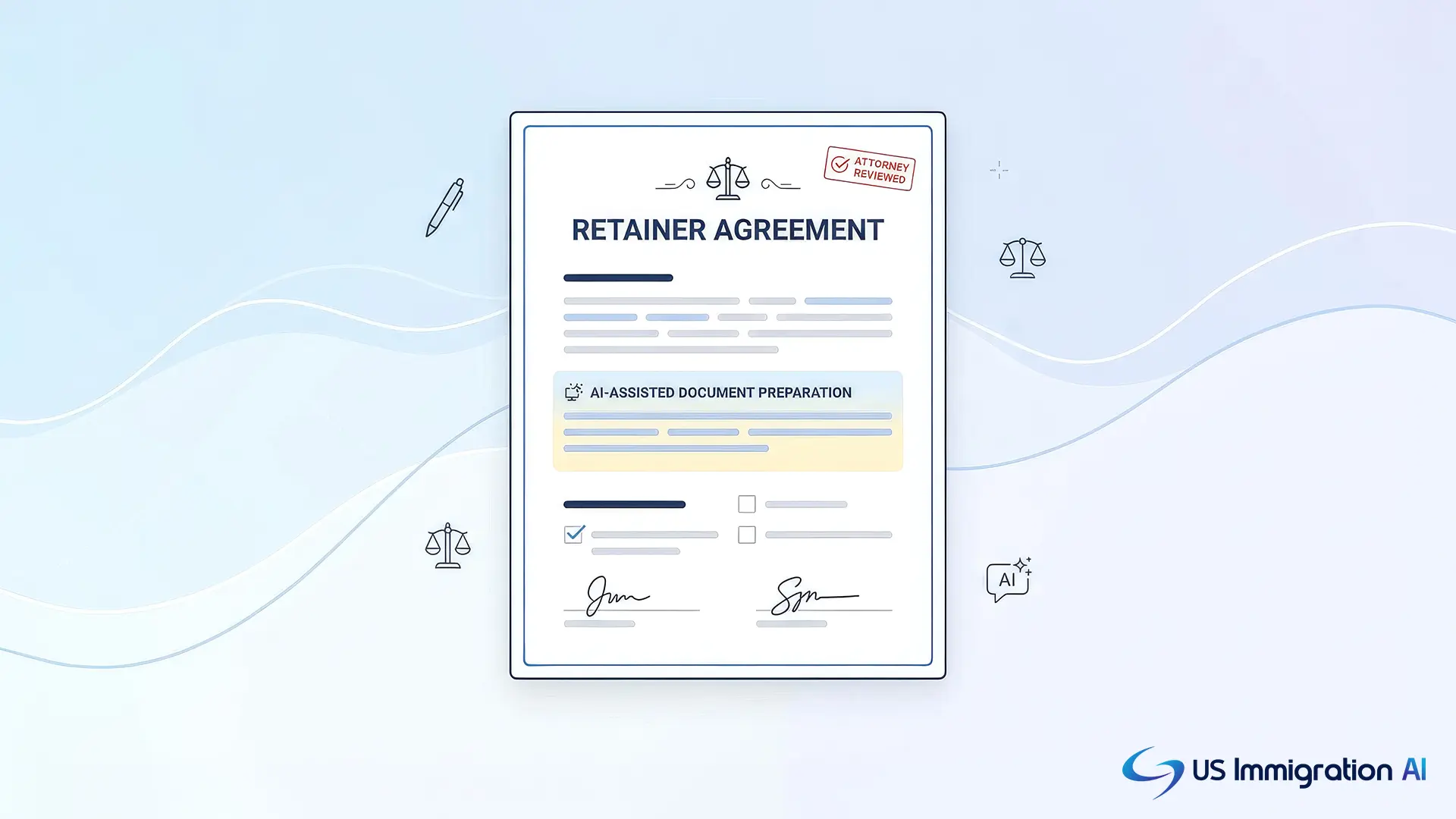
No list covers every situation, so lawyers weigh the client's needs, the scope of the work and the information's sensitivity (Op. 512 at 9). Even without a requirement, lawyers may explain their AI use to clients. The opinion calls the engagement agreement a logical place to do that and to record client instructions on AI use.
A short retainer clause is a good place to start, though it does not replace specific consent. The AI Retainer solution drafts the agreement for attorney review first, so a sample like this fits there:
Our firm may use AI-assisted software to help prepare forms, letters and other documents for your case. An attorney reviews all AI-assisted work before it is filed. We will not enter your personal information into an AI tool without explaining how the tool uses it and asking for your permission.
Candor (Model Rules 3.1, 3.3 and 8.4(c)): What Reaches the Court
Work product also reaches tribunals, and there the duties run to the court as well as the client (Op. 512 at 9). For court filings, the opinion says the following:
- Lawyers should review AI output, including analysis and citations to authority, before submitting it to a court (Op. 512 at 10).
- Errors to correct include misstatements of law and fact, missing controlling authority and misleading arguments (Op. 512 at 10).
- Even an unintentional misstatement to a court can be a misrepresentation under Rule 8.4(c) (Op. 512 at 9-10).
- Some courts require disclosure of AI use, so lawyers should check each court's local rules (Op. 512 at 10 n.47).
In Mata v. Avianca, a New York federal court fined two lawyers and their firm $5,000 on June 22, 2023. Their brief cited opinions that ChatGPT had invented.
Verification in an immigration firm means opening each cited decision, confirming the quote and checking that the rule is current before filing. A drafting tool such as AI Legal Document Drafting saves typing time, and the attorney's review is where accuracy gets confirmed.
Supervision (Model Rules 5.1 and 5.3): Staff, Representatives and Vendors
Supervision extends the earlier duties to everyone who touches AI output. Under Rules 5.1 and 5.3, managerial lawyers must set clear policies on the firm's permissible use of AI (Op. 512 at 10). Supervising lawyers must make reasonable efforts to see that lawyers and nonlawyers comply and are trained in the tools they use.
Training can cover how the technology works, its limits, ethical issues and secure data handling (Op. 512 at 10). One training suggestion is to mark AI-produced materials in the file so later users know the work can be wrong (Op. 512 at 10 n.52).
Paralegals and representatives also handle AI output in immigration practice. Under 8 CFR 292.3, the practitioners who can be disciplined include attorneys and representatives as defined in 8 CFR 1.2. A written policy naming approved tools, their users and the reviewer gives each of them one rule to follow.
Vetting AI Vendors
Rule 5.3(b) requires reasonable efforts to ensure an outside provider's conduct fits the lawyer's obligations (Op. 512 at 11). The opinion points to vendor credentials, security policies, hiring practices, confidentiality agreements and conflicts checks, and says the same concepts apply to AI providers. Written questions make those checks routine:
- Does the tool store what users enter, and for how long?
- Does the vendor use client inputs to train its models?
- Who at the vendor can see client data?
- Can the firm delete client data on request, including after the contract ends?
- Does the vendor claim any rights to the information submitted?
- Which outside providers or third-party models receive the data?
- Will the vendor notify the firm of a breach or a legal demand for client information?
- What limits does the vendor place on its liability?
- Are these answers written into an enforceable contract?
Fees (Model Rule 1.5): Billing When AI Saves Time
Fees come last: Rule 1.5 asks whether the bill is reasonable. It applies to any representation in which a client is charged for the use of AI (Op. 512 at 11).
Hourly and Flat Fees
A lawyer who bills by the hour may bill only for time actually spent (Op. 512 at 12). If a drafting tool takes 15 minutes of input, the lawyer may charge those 15 minutes plus the time spent reviewing the draft.
Flat and contingent fees face the same test under the Rule 1.5(a) factors (Op. 512 at 12). If a tool lets a lawyer finish tasks much more quickly, charging the same flat fee as before may be unreasonable. The opinion quotes a Maryland decision: "A fee charged for which little or no work was performed is an unreasonable fee."
Expenses and Learning Time
Charging for AI tools starts with explaining the basis for the charge, preferably in writing (Op. 512 at 12). Overhead, such as a grammar checker built into word-processing software, is not billed to the client without advance disclosure. A per-use third-party service, such as contract review, can ordinarily be charged at actual cost (Op. 512 at 13).
Time spent learning a tool the lawyer will regularly use cannot be billed to the client (Op. 512 at 14). The exception is a client who explicitly asks for a specific tool the lawyer does not know. Both should agree on that billing first.
California's 2026 practical guidance, presented to the State Bar's Board of Trustees on May 14, 2026, addresses pass-through costs. Specialized per-use costs may pass to the client when the fee agreement discloses them and the charge matches actual cost. A markup needs informed written consent.
How EOIR and 8 CFR 1003.102 Add a Second Layer for Immigration Firms
Beyond the six duties, immigration practitioners answer to EOIR. EOIR Policy Memorandum 25-40, Use of Generative Artificial Intelligence in EOIR Proceedings, took effect on August 8, 2025. It sets no blanket ban on generative AI and no mandatory disclosure rule.
The memo cites Opinion 512 twice, for the model rules that AI use implicates and for when a lawyer may need to tell a client. It tells practitioners to confirm the accuracy of citations, research and drafting done with AI tools.
Filing hallucinated or erroneous AI-generated content likely violates professional conduct obligations, the memo adds. Judges and the Board may adopt standing orders on AI, so check each courtroom's rules. For USCIS filings, Opinion 512 and your state's rules remain the main guides.
Grounds for Discipline Under 8 CFR 1003.102
Several grounds for discipline in 8 CFR 1003.102 could apply to AI errors, according to the memo:
- Knowingly or with reckless disregard making a false statement of material fact or law (paragraph (c)).
- Conduct that is prejudicial to the administration of justice (paragraph (n)).
- Failing to provide competent representation (paragraph (o)).
- Failing to disclose adverse controlling legal authority (paragraph (s)).
- Repeatedly drafting filings that reflect little or no attention to the specific factual or legal issues (paragraph (u)).
Immigration Cases Where AI-Generated Citations Reached a Court
Two 2026 decisions involved AI-generated citations in immigration cases. In Lnu v. Blanche, No. 24-4790 (9th Cir. June 3, 2026), a brief signed by attorney Mike Singh Sethi cited two nonexistent cases. A brief writer who was not yet licensed had drafted it, and no licensed attorney had checked the citations.
That published order did not sanction AI use itself. It found that Sethi and attorney William Rounds made false statements of candor when they called the errors typographical or denied using AI. Each paid a $2,500 fine and received a six-month suspension from practice before that court, followed by two years of AI-use disclosure statements.
At the BIA, Matter of Sethi, 30 I&N Dec. 112 (BIA 2026), followed on October 1, 2026. The Board imposed reciprocal discipline, suspending Sethi for six months from practice before the Board, the immigration courts and DHS, effective June 13, 2026. It said an attorney's conduct duties apply whatever tools prepare a filing.

Where These Duties Show Up in Everyday Immigration Work
Routine tasks raise the same duties as the court filings above. These four examples are illustrations and not reports of real cases, and each pairs a task with the duty it touches and a simple control.
State Bar Guidance Since July 2024
Generative AI tools are a rapidly moving target, the opinion says, and bar ethics committees are expected to issue updated guidance (Op. 512 at 2). Its consent conclusion rests on tool risks as of publication and may change as the technology develops (Op. 512 at 7 n.34).
NYC Bar Formal Opinion 2024-5 (August 7, 2024) says advance client consent must be informed and AI output must be checked. California's guidance, noted under fees, also covers consent for tools with material risk, agentic AI and client limits on AI. Your own state bar may have more.
A Firm AI Policy Starter for Immigration Practices
Seven items are enough for a one-page policy that covers the duties above:
- Name the approved AI tools and the person who approves new ones.
- Adopt a data rule for each category in the data table, and record client consent in the matter file.
- Require an attorney to sign off on every AI-assisted filing after checking its citations.
- Train each user when a tool is adopted and again when its features change.
- Send each vendor the written questions above and keep the answers on file.
- Mark AI-produced materials as such in the matter file.
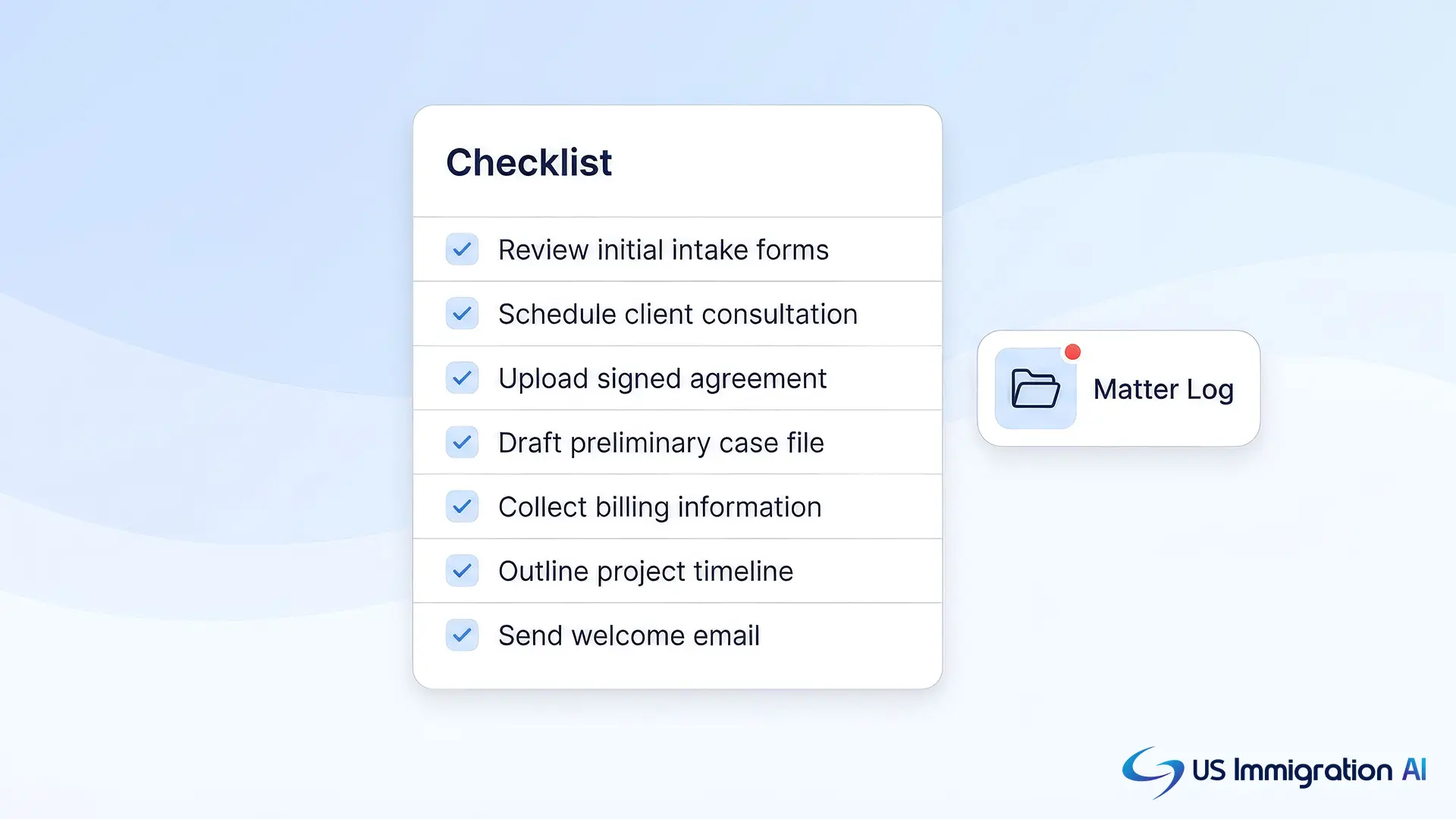
- Log AI use on each matter with six fields: tool, task, data entered, reviewer, date and billing treatment.
Such a log gives the firm a record if a judge, client or bar counsel asks how AI was used.
Grow Your Caseload With US Immigration AI
US Immigration AI is AI-powered immigration case management software. It runs the work from first lead to final filing, from intake and retainers to document collection, form drafting and case assembly. Schedule a demo to see how that workflow fits inside a firm AI policy like the one above.
Frequently Asked Questions