
An I-797 Notice of Action is the letter USCIS uses to communicate almost every decision it makes on a case. For a firm, it is also the document that starts a clock. The type of notice determines who on staff should open it, what deadline it triggers, and what happens next in the file.
Most guides written on this topic explain the notice from the client's point of view. This one is built for the desk where the notice actually lands first. It walks through every I-797 type, the deadline each one sets, and a workflow for routing, calendaring, and verifying these notices before they slip past a due date.
Key Takeaways
- Form I-797 covers several distinct notice types, and each one calls for a different action and a different owner inside the firm.
- A Request for Evidence gives 84 days to respond, or 87 days when USCIS mails it, under the USCIS Policy Manual.
- A Notice of Intent to Deny runs on a shorter clock: 30 days, or 33 if mailed.
- Since October 28, 2025, USCIS no longer accepts paper checks for most filings, which makes a rejected payment (not just a lost notice) a real cause of intake delay.
- The receipt number on every notice follows a fixed 13-character format, which staff can use to catch a fake before acting on it.
- A consistent intake-to-routing process is what keeps a missed biometrics appointment or RFE deadline from becoming a malpractice exposure.
What Is an I-797 Notice of Action?
An I-797 Notice of Action is the letter USCIS uses to report a decision or update on a filed application or petition. USCIS generates it once an event happens on the case, such as accepting a filing, scheduling biometrics, or requesting more evidence, and mails or emails it automatically. It is not a form anyone fills out.
For a firm, the notice is usually the first piece of paper (or PDF) that lands after a filing goes out. What happens to it in the next hour often matters more than what it says.
A receipt notice needs to be logged and matched to the file. An RFE needs to reach an attorney the same day. A biometrics notice needs a calendar entry before anyone forgets the appointment exists.
The I-797 Family: What Each Suffix Means and Who Should Handle It
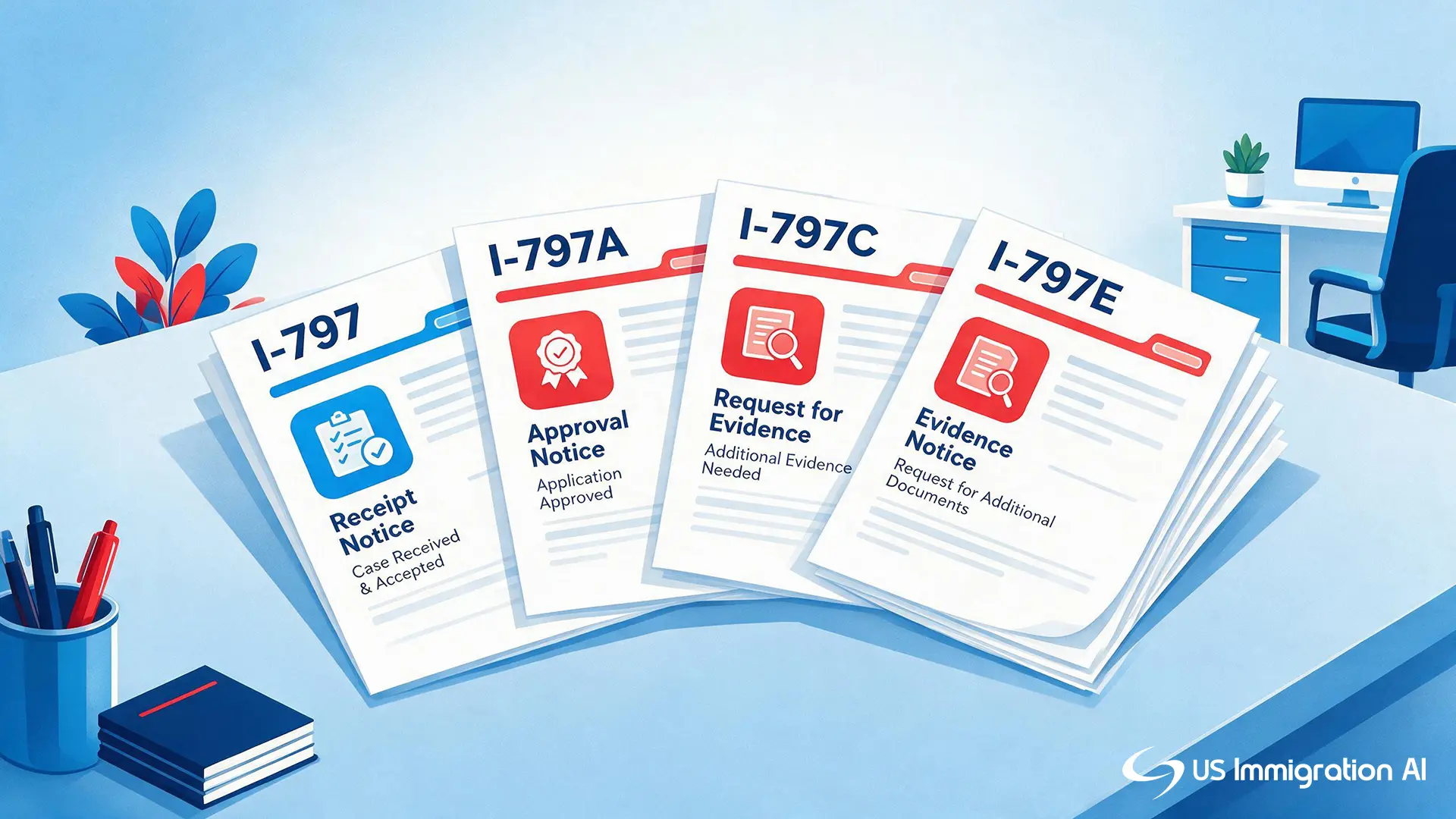
Knowing what to do with a notice starts with knowing what type just landed. USCIS uses a single form number with different letter suffixes to separate one type of notice from another, and knowing the suffix on sight is what lets a front-desk staff member route a notice correctly before an attorney ever sees it.
Form I-797 (No Suffix)
This is the base notice, generally used to confirm that USCIS has received or approved a filing. A front-desk or intake team member can log it and update the case status without attorney review, unless the notice contains an unexpected outcome.
Form I-797A
This version approves a change of status or extension of stay filed on Form I-129 or a related petition, and it includes a tear-off Form I-94 at the bottom. Staff should scan the new I-94 into the client's file immediately, since it is the client's proof of status until the next filing.
Form I-797B
This approves a worker petition for a beneficiary who will complete consular processing abroad rather than adjust status inside the U.S. It does not include an I-94. Paralegals typically use it to trigger the next step: preparing the consular processing packet.
Form I-797C
Form I-797C covers a range of updates. It can confirm receipt, reject a filing, transfer a case between service centers, reopen a case, or schedule an appointment for biometrics or an interview. USCIS's own Form I-797C, Notice of Action page confirms this single form carries all of those uses.
Because one form covers so many outcomes, staff should read the notice type line at the top first. That line determines what happens next, so no one should assume every I-797C is routine.
Form I-797D
This is a cover letter that accompanies a benefit card, such as a green card or an employment authorization document. No action is required, but it should be scanned and matched to the card before either is filed away.
Form I-797E (Request for Evidence)
This notice, commonly referred to as an RFE, tells the firm that USCIS needs more evidence before it will decide the case. It always carries a hard deadline. This is the one notice type that should reach a supervising attorney the same business day it arrives, since building the response is the highest-stakes task any I-797 creates.
Form I-797F (Transportation Letter)
This letter allows a lawful permanent resident abroad who lost or damaged a green card to board a flight back to the United States. It is time-sensitive but rare, and it usually needs an attorney's direct involvement to coordinate with the client's travel plans.
I-797 Types at a Glance
The breakdown above works as a quick reference once the routing rules are second nature:
What Deadline Clock Each Notice Starts
The table above shows which I-797 Notice of Action types carry a deadline. The exact math behind each one is where firms take on the most risk if they get it wrong.
Request for Evidence: 84 to 87 Days
The USCIS Policy Manual, Volume 1, Part E, Chapter 6 sets the maximum response time for a Request for Evidence at 84 days. Regulations do not allow officers to extend that period. When USCIS mails the RFE, a response still counts as timely if it arrives within three extra days, for a total of 87 days.
Shorter Windows on Form I-539 and I-601A Filings
That 84-day standard has exceptions. Extension or change of status requests filed on Form I-539, and provisional unlawful presence waiver requests on Form I-601A, generally get 30 days rather than the standard 84. Staff pulling a deadline from a notice should confirm the form type before assuming the standard timeline applies.
Notice of Intent to Deny: 30 to 33 Days
Not every notice runs on the RFE clock. A Notice of Intent to Deny is a different notice entirely, and it runs on a shorter schedule. The same Policy Manual chapter sets its maximum response time at 30 days, or 33 days when the notice is mailed. Treating a NOID like a standard RFE, and assuming an 87-day window, is a fast way to miss a deadline that was actually less than half that long.
Biometrics and Interview Appointments
Biometrics and interview notices set a fixed appointment date rather than a response window. Under the USCIS Policy Manual, Volume 1, Part C, Chapter 2, a reschedule request must go through a myUSCIS account or the USCIS Contact Center, not by mail or in person, and it needs to be submitted before the appointment time with a valid reason. An attorney with Form G-28 on file can submit that request directly on the client's behalf. Missing the appointment without a timely reschedule request puts the case at risk of a denial for abandonment.
Building the actual RFE response, once the deadline is calendared, is where AI Legal Document Drafting fits into the workflow: pulling the original intake data back into a response letter instead of starting from a blank page.
Building an Intake-to-Routing Workflow for I-797 Notices
A deadline only matters if someone owns it. Firms that consistently avoid missed RFEs and biometrics notices tend to run the same basic steps every time a notice arrives, regardless of who happens to open the mail that day.
- Log it same day. Record the receipt number, notice type, and date on the notice itself, not the date it was opened. USCIS calculates deadlines from the date printed on the notice.
- Match it to the file immediately. A notice that sits unmatched to a case is a notice nobody is tracking. Confirm the client name and receipt number against the case management record before moving on.
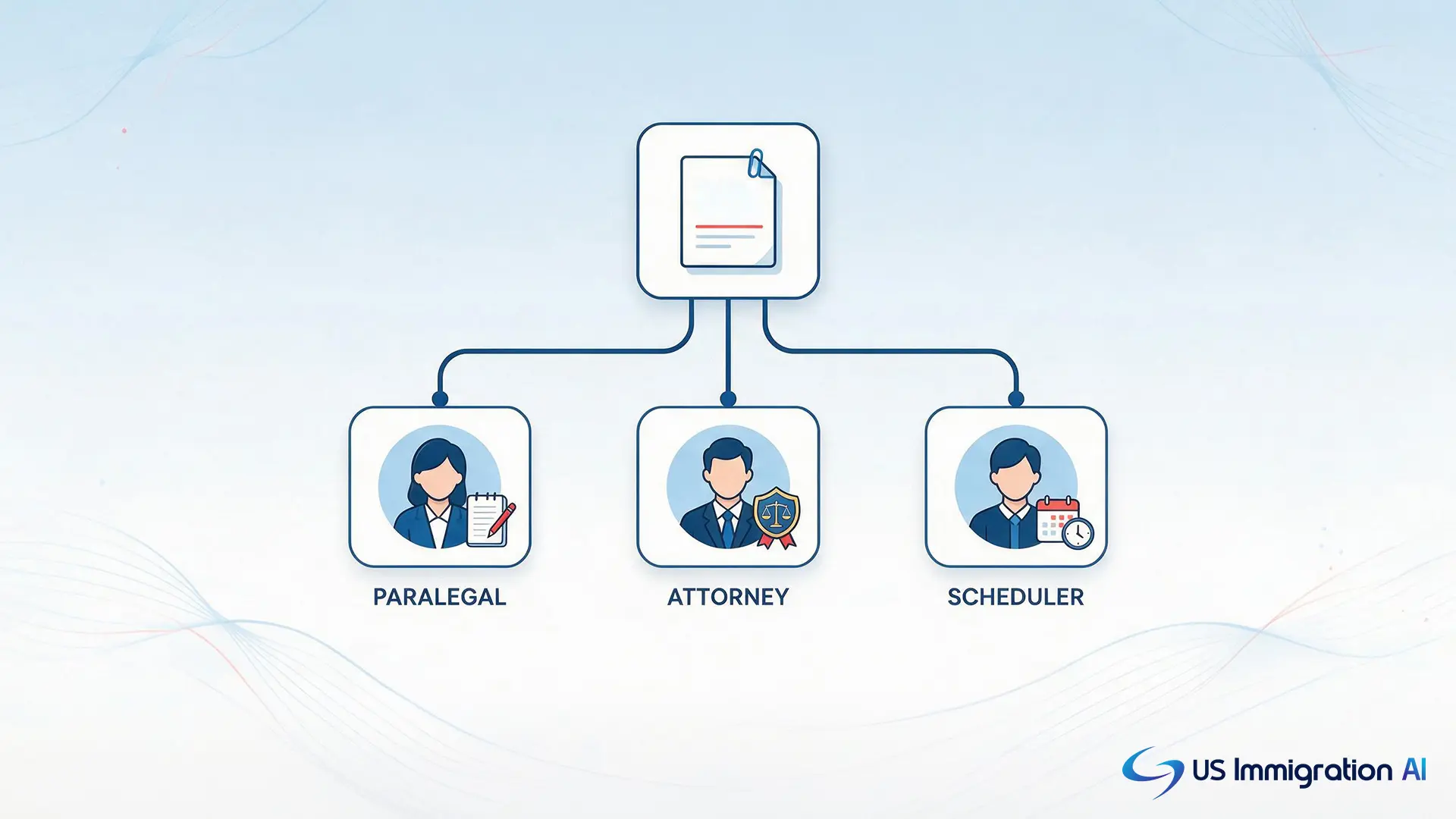
- Route by type, not by whoever is available. An RFE goes to the supervising attorney. A biometrics notice goes to whoever owns the firm's appointment calendar. A plain receipt notice can stay with intake staff. Written routing rules remove the guesswork during a busy week.
- Set a review buffer before the real deadline. Calendar the internal review date at least 10 business days before the actual USCIS deadline, so there is time to gather evidence, not just time to notice the deadline is close.
- Escalate automatically at a threshold. If an RFE has not been assigned a response owner within 5 business days of logging, route it to a supervising attorney for review, no exceptions.
This is the kind of case tracking that AI Case Assembly is built to carry, since it keeps every notice tied to its deadline and its file instead of a loose stack of mail.
That five-step routine assumes a notice actually arrives in the first place. Two failure points sit upstream of it.
When a Filing or Notice Doesn't Show Up
Some of the most common breakdowns happen before a notice ever gets written, or after USCIS mails one that never reaches the file. A few changes are worth building into intake.
Paper Filings Now Require Electronic Payment
As of October 28, 2025, USCIS stopped accepting personal checks and money orders for most filings. Payment must go through Form G-1650 for an ACH bank debit or Form G-1450 for a card, with a rare paper exemption available only through Form G-1651. A rejected or mismatched payment stops a filing before it ever reaches an examiner, which means no receipt number and no I-797 to track in the first place.
One older workaround is worth retiring: some firms used to locate a lost receipt number by checking the case number USCIS stamped on the back of a cashed check. That option no longer exists for most filings now that checks are off the table, which makes the digital tracking steps below more important than they used to be.
A Stale Address Is the Most Common Reason a Notice Never Arrives
Federal law requires most noncitizen clients to report a move to USCIS within 10 days, using Form AR-11. A notice mailed to an old address is typically returned to USCIS as undeliverable rather than forwarded, so building an address confirmation question into every client check-in, especially before a major filing, catches this before it costs a deadline.
Form G-1145 Gets a Digital Confirmation Weeks Before the Mailed Notice
Attaching this free, optional form to the top of a paper filing gets the firm a text or email within 24 hours of USCIS accepting the case, well before the mailed I-797C receipt notice typically arrives. It is a small step that closes a multi-week visibility gap on every paper filing.
Know the Waiting Period Before Filing a Non-Delivery Inquiry
If a notice or document still hasn't arrived, USCIS has a waiting period before it will accept an inquiry, and filing a non-delivery request too early gets rejected outright. The standard windows are roughly 30 days for a missing notice or document, and at least 90 days for a missing card, through USCIS's own e-Request tool.
A notice that shows up on time still has to be genuine before staff act on it. That's a separate check worth building into the same intake step.
Verifying a Notice Is Genuine Before Staff Act on It
Most I-797 notices are exactly what they claim to be, and treating every one as a potential fraud attempt would slow a firm down for no reason. A quick, routine check is still worth running. USCIS's own Avoid Scams page notes that applicants, petitioners, and requestors can become targets of scams during the immigration process, and a firm handling volume is a bigger target than a single applicant.
Confirm the Receipt Number's Format
USCIS's Checking Your Case Status Online page describes the receipt number as a 13-character code: three letters followed by ten digits, drawn from a known set of service center prefixes. A number that does not fit that pattern is worth a second look.
Cross-Check the Case Status Online
Run the number through USCIS's own case status tool rather than trusting the notice alone. A mismatch between the online status and the notice is the signal to call USCIS directly. USCIS's Common Scams page directs anyone who suspects fraud to report it through the agency's official tip form, rather than replying to the suspicious contact.
Once a notice is logged, matched, and verified, keeping it organized falls to whoever manages the client's file. The Immigration Client Portal gives staff one place to store it alongside the evidence gathered to respond to it.
Where This Leaves Your Intake Desk
Put logging, routing, and verifying together, and an I-797 Notice of Action stops being a risk. Left to chance, it stays routine mail until the wrong person opens it, or the right person opens it three weeks too late.
A fixed process fixes that: log it, match it, route it, calendar it, and verify it the same way every time. That habit turns routine mail into a predictable task instead of a recurring risk.
Keep Every I-797 Moving With US Immigration AI
You shouldn't need a spreadsheet and a prayer to know which RFE is due this week. US Immigration AI connects your intake, document collection, drafting, and case assembly in one workflow, so every I-797 notice is logged against its deadline the moment it arrives, no matter who on your team opens it first. Your attorneys still review every filing before it goes out; the platform just keeps the deadlines from getting lost in between. Book a consultation and see how it fits the way your firm already works.
Frequently Asked Questions