

An H-1B status check tells you where a client's petition stands with USCIS, using the receipt number from Form I-797. For an individual applicant, that is a quick lookup. For a law firm, it means repeating that lookup across dozens or hundreds of open H-1B cases, often several times a week.
This guide covers the mechanics of an H-1B status check first. Then it goes further into what firms actually need: a way to track many cases at once, know the moment something changes, and prove to a client that their case was being watched the whole time.
Key Takeaways
- An H-1B status check uses the receipt number on Form I-797 to look up a case on the USCIS Case Status Online portal.
- Individual lookups work fine for one case. Firms managing dozens of active H-1B matters need a repeatable, assigned process instead.
- Staff access, escalation timing, and documentation matter as much as the lookup itself once your firm has real case volume.
- A record of when a status was checked, and by whom, protects the firm if a client later disputes being told in time.
- Centralized case tracking software removes the manual, one-by-one lookup entirely.
What Is an H-1B Status Check?
An H-1B status check is a lookup of where a filed H-1B petition stands with USCIS. According to USCIS, it uses a 13-character receipt number assigned to every accepted application or petition (USCIS Receipt Number).
That receipt number appears on Form I-797, Notice of Action, which USCIS sends after receiving the petition. The case falls under the nonimmigrant temporary visa category, alongside other work-authorization filings your firm may already track.
Once you have the receipt number, checking status is straightforward for a single case. The complexity shows up when a firm is doing this across a full caseload, not once.
How to Check H-1B Status With USCIS
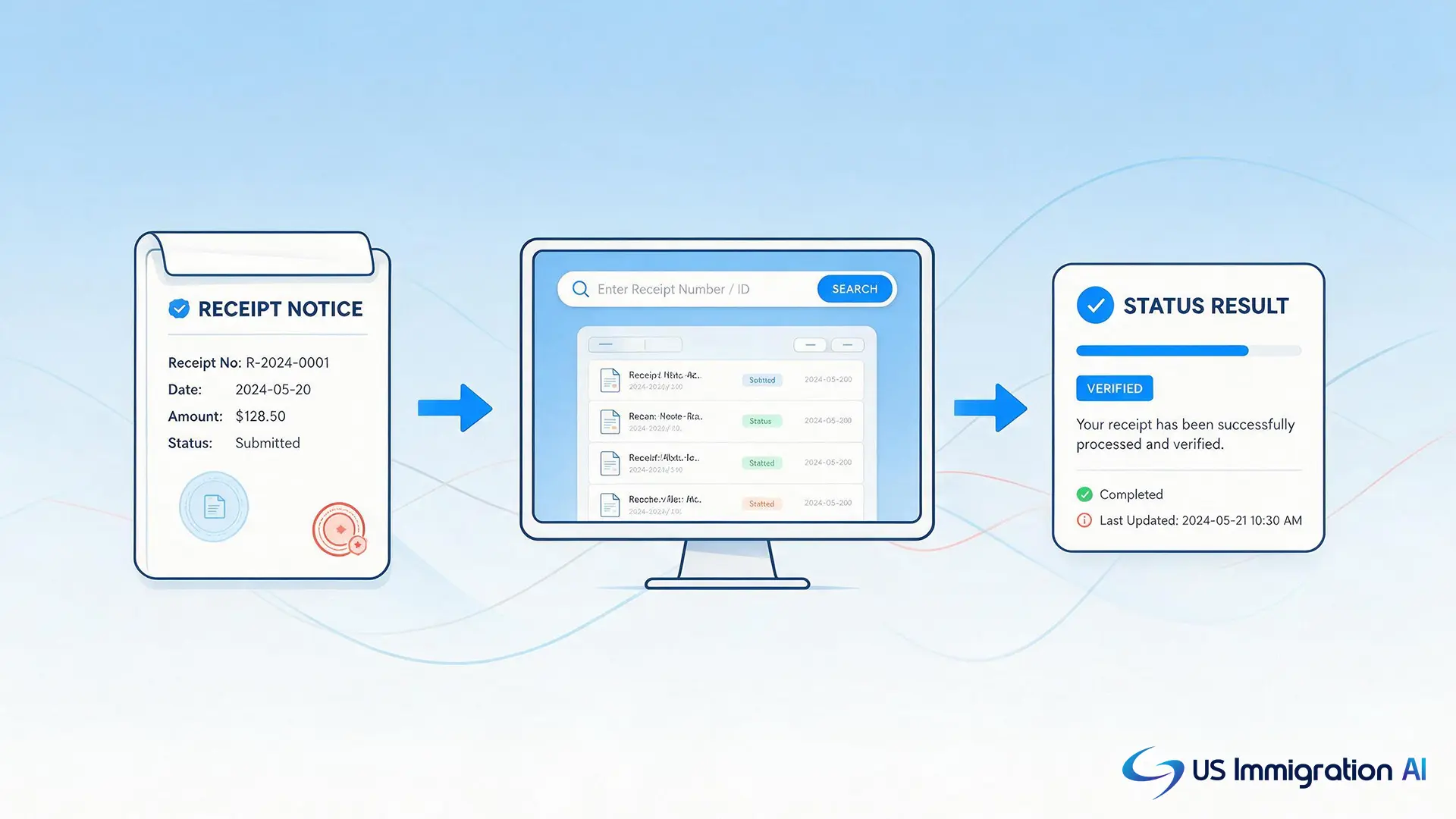
USCIS offers two main ways for your staff to check a client's H-1B status: a direct lookup tool for one case at a time, and an attorney account that links several client cases to a single login.
Using the USCIS Case Status Online Tool
The USCIS Case Status Online portal is the fastest way to check a single case.
Here is what the lookup takes for one client:
- Go to the USCIS Case Status Online portal.
- Enter the 13-character receipt number from the client's I-797.
- Submit the form to see the current status.
- Opt in to email or text notifications on the client's behalf, so future updates arrive automatically.
Setting Up a USCIS Online Attorney Account
An attorney account lets your firm link several client cases to one login instead of a staff member checking each one separately.
- Create an account at myaccount.uscis.gov.
- Verify your identity and set up two-factor authentication.
- Add each client case using their receipt number and any access code USCIS provides.
- Review linked cases from a single dashboard.
An attorney account still shows one case at a time within the dashboard. Either method displays the same set of status labels, so the next question is what those labels actually mean and which ones need fast action.
Understanding USCIS Status Updates
Each status update tells you what stage a petition is in and whether action is needed.
- Received: the petition is in processing.
- Request for Evidence (RFE): USCIS needs more documentation before it can proceed.
- Approved or Denied: a final decision has been issued.
- Transferred: the case moved to a different USCIS service center.
An RFE is the status most likely to need a fast response from your firm. USCIS caps the response window at 84 days from the RFE's date, or 87 days if it was mailed, and missing that deadline can lead to a denial (USCIS Policy Manual, Volume 1, Part E, Chapter 6).
Knowing what these labels mean only covers the lookup itself. The harder part for a firm is keeping every case's status current without checking each one by hand.
Why Status Tracking Gets Harder at Firm Scale
Checking one case is simple. Checking fifty or five hundred, on a recurring schedule, without missing an RFE deadline, is a different problem entirely. The sections below cover the parts of H-1B status tracking that come up once a firm has real case volume.
Tracking Multiple Cases Without Manual Lookups
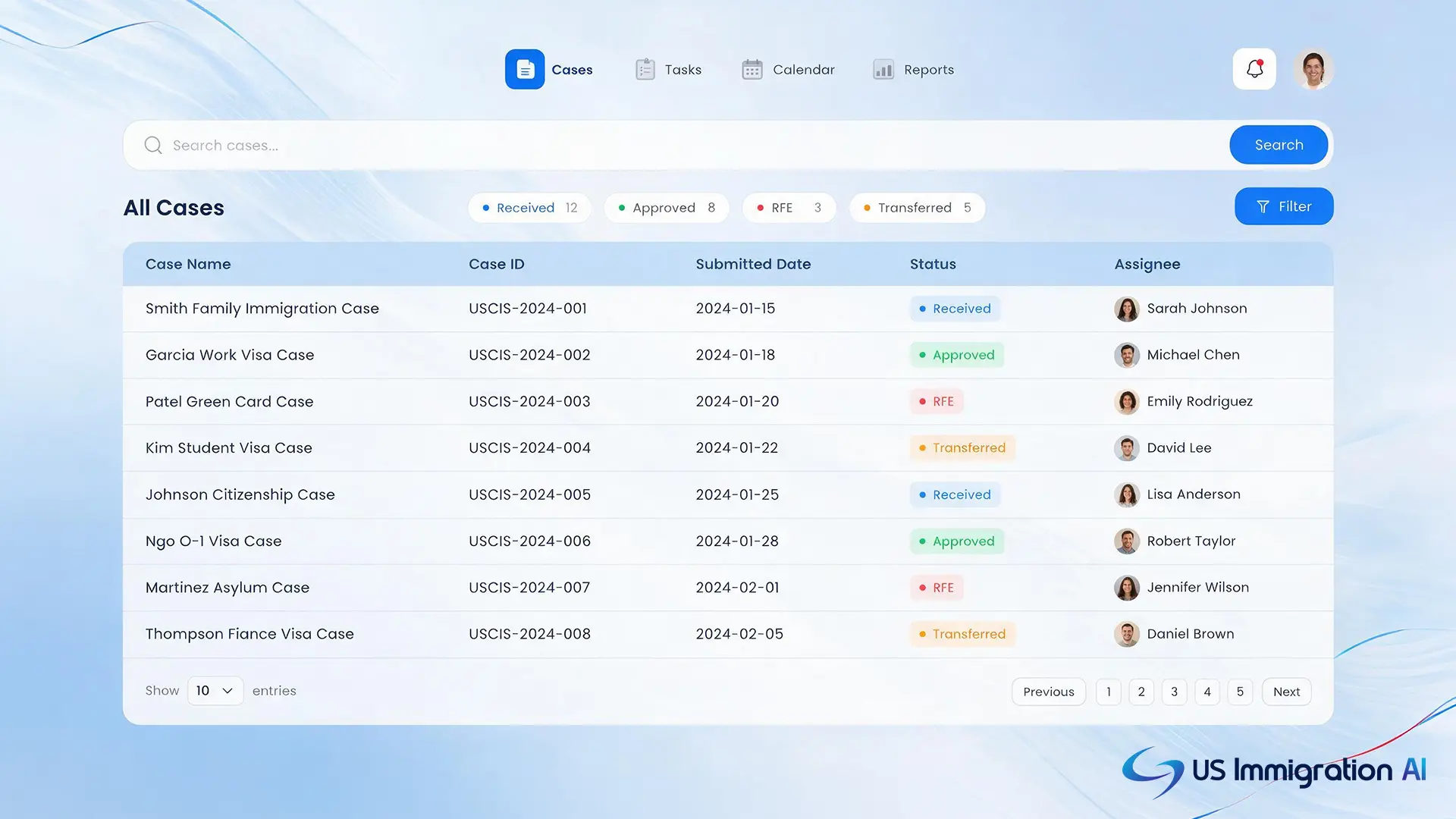
Re-entering receipt numbers one at a time does not scale past a handful of cases. Firms with larger H-1B dockets need a single view that shows every case's status together, sorted by urgency or deadline.
This is the type of work AI Case Assembly is built for: keeping every open case, its current status, and its next deadline in one place instead of a spreadsheet your team updates by hand.
Staff Access and Account Handoffs
Decide up front whether each paralegal holds an individual USCIS attorney account. The alternative is a smaller number of shared, centrally managed accounts. Individual accounts give clearer ownership. Shared accounts are easier to reassign when someone leaves.
Either way, write down what happens when a staff member with linked cases leaves the firm. Cases tied to a personal account need a documented handoff, not a scramble to regain access.
Escalating RFEs and Status Changes Internally

Set a rule for who sees a status change first and how fast the client hears about it. A common structure: the assigned paralegal reviews the update within one business day, and any RFE goes to the supervising attorney the same day it appears.
Client communication about the change should go out on a set schedule too, not whenever someone notices the update. A client portal that shares status updates directly with the client can shorten this step and keep the conversation in one place.
Documenting Status Checks for the File

Keep a simple record of when each case was checked and by whom. If a client later says they were not told about an RFE or a delay in time, this record is what shows the firm was actively monitoring the case.
A dated note in the file, or a system that logs each check automatically, both work. What matters is that the record exists before it is needed.
Billing Time for Status Monitoring
Decide whether routine status checks are billable, and be consistent about it across the firm. Some firms bill a small block of time per case per month for monitoring. Others treat it as included overhead and bill only the work that follows a status change, like responding to an RFE.
Either approach is workable. The problem is inconsistency, where some attorneys bill it and others do not.
Spotting Patterns Across Your Caseload
Once status data is centralized, it can tell you more than the state of one case. Tracking RFE rates by case type, or noticing that one service center is running slower than usual, helps a managing attorney staff and prioritize work with better information.
This kind of pattern only becomes visible once cases are tracked in one system rather than checked individually.
Building a Reliable Status-Tracking Habit
Access, escalation, documentation, billing, and pattern-spotting all point to the same conclusion. The lookup itself, receipt number in, status out, is the easy part of an H-1B status check. The process around it is what separates a firm that scales smoothly from one that misses deadlines: who checks, how often, what happens when something changes, and what gets written down.
Put that process in writing once, assign clear ownership, and revisit it as your H-1B caseload grows.
Grow Your Caseload With US Immigration AI
US Immigration AI keeps every open case, its current status, and its next deadline visible in one place. No RFE waits on someone remembering to check the portal. A licensed attorney still reviews every file before it moves forward. Schedule a demo to see how it fits your firm's caseload.
Frequently Asked Questions