
Keep Every I-485 Form and Supporting Document in One Client File
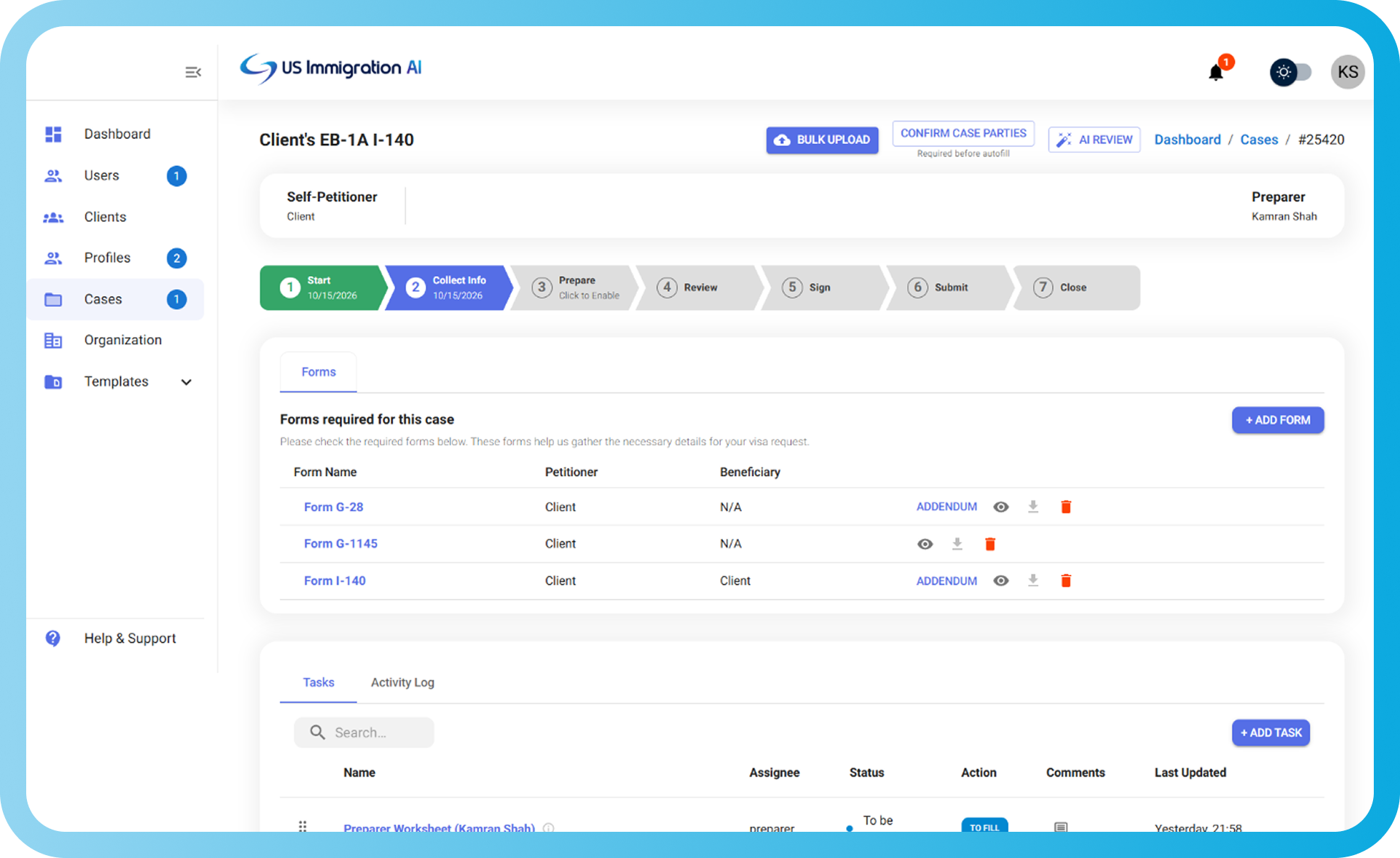
An adjustment of status filing spreads across the I-485, companion forms, civil records, and category-specific evidence. Each applicant in a household adds another full set. US Immigration AI keeps all of it in one client file, built from a single set of intake answers.
Packets by Category
Match the Packet to the Category You Are Filing Under
- Family-Based Adjustment
- Employment-Based Adjustment
- Humanitarian and Waiver-Related Adjustment
- Concurrent Filings

What the Platform Handles for Adjustment of Status Cases
Enter Applicant Data Once
Capture names, dates, addresses, status, and background during AI Intake. Those answers fill every form in the packet, so no one retypes them.
Collect by Category
Send each client a document checklist matched to their filing. Attorneys can add or remove requests for unusual cases.
Chase Missing Documents
Track which files are still outstanding, such as civil records, tax history, and medical records. Reminders go out through the client portal until each item is uploaded.
Keep Households Together
Track each family member's filing as its own matter, linked under the household it belongs to. Shared evidence, like a marriage certificate, stays attached to every filing that needs it instead of being uploaded once per person.
Draft the Filing Forms
Generate the I-485 and related forms from intake data and attorney-approved templates with AI Legal Document Drafting. Empty fields, missing signatures, and conflicting dates are flagged before anything is printed.
Assemble and Review
Combine forms, evidence, and exhibits into one packet with a labeled index through AI Case Assembly. Your attorney reviews every page, then makes the decision to file.
Two Filings, Years Apart
Catch the Missing Signature Before USCIS Does
An unsigned form or a conflicting date is the kind of gap that triggers a rejection notice weeks later, not a same-day fix. See how the platform catches those gaps on your own adjustment of status cases.
Before and After
Managing Adjustment of Status Filings Without US Immigration AI
Staff retype applicant details into the I-485 and every companion form.
Clients are emailed one by one for civil records, tax history, and medical results.
A missing signature or conflicting date turns up at the last review.
The petition and the I-485 are rebuilt separately for a concurrent filing.
Staff sort, label, and paginate the packet by hand.
Managing Adjustment of Status Cases Without US Immigration AI
With US Immigration AI
Details are entered once and fill the whole packet.
Clients follow one checklist and get reminders until every file is in.
Gaps are flagged before the packet reaches your attorney.
Both are drafted from the same intake answers.
The exhibit index and pagination are built automatically.
Why Firms Run Adjustment of Status Cases on US Immigration AI
Built Around USCIS Filings
The platform follows the structure and formatting that immigration packets require, instead of adapting a general case tool. Your team is not bending a generic system to fit immigration work.
Attorney Review Built In
Every packet is pre-filled, checked, and assembled for your attorney to review before filing. Nothing goes out without a lawyer's sign-off.
One Platform From Intake to Filing
Intake, retainers, document collection, drafting, and case assembly share one set of client data. See how the stages connect on the How It Works page.